Showing posts with label xbox 360. Show all posts

Wednesday, August 18, 2010

Continuum Shifts; Quality Doesn't

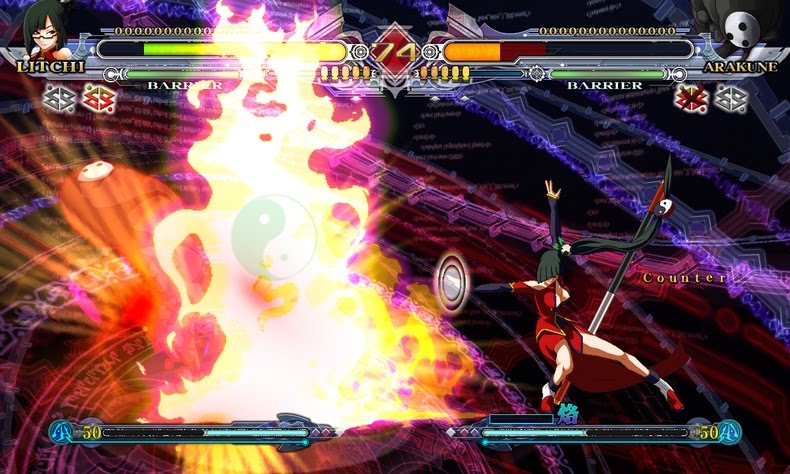
This time last year I gave a rave review to BlazBlue: Calamity Trigger, the new fighting game from the developers of the Guilty Gear series. I didn't expect that I would be back this year to review a new installment in the BlazBlue series, yet here I am, once again delivering a thoroughly positive take on Arc System Works' latest production.

I was slightly disappointed when BlazBlue: Continuum Shift was announced. Though I was glad to see a great game get a sequel, it initially appeared that the "new" game would include relatively little new content. There were four new characters, a few new stages, and adjustments to existing characters, but I worried this would be as disappointing an upgrade as the reiterations of Guilty Gear X2. Given Arc System Works's history, I wasn't wrong to worry, but I'm glad to say that Arc has come through this time. BlazBlue: Continuum Shift is so chock-full of new content that it makes its predecessor's abundance seem paltry.

Though there are several very obvious differences between Continuum Shift and Calamity Trigger, Arc System Works have also demonstrated admirable attention to detail with a whole slew of small changes. The first game's slapdash menus have made way for a more elegant setup. If the short load times bother you, you can now shorten them still further by installing the game, which takes about five gigabytes on the hard drive. All the new characters have new portraits, the art gallery has twice as many unlockables, and the in-battle "HUD" has been redesigned.

When the Guilty Gear games first appeared, they were praised for their beautiful sprite graphics and smooth animation, which made most 2D and many 3D fighting games appear dowdy and outdated. The BlazBlue franchise's HD sprites surpass their Guilty Gear precursors, though I admit I rather miss the old games' sprite backgrounds. The 3D backgrounds in Continuum Shift are lively, detailed, and full of spectators and moving parts, but Arc System Works' 3D output never approaches the beauty of their 2D work. The stages, though not unsightly, represent a missed opportunity.

In an interview from 2008, Daisuke Ishiwatari of Arc Systems Works compared his games with games like Street Fighter IV, which claim to be user-friendly but which are impenetrable to those unfamiliar with fighting games, their history, and their terminology. As he put it: "In my own opinion, no matter what the game, it's important to make sure that beginners and non-gamers can pick it up, and have fun just mashing the buttons." Calamity Trigger, with its Drive (i.e. X Button/A button) attacks and right-stick special attacks, achieved this goal quite well, but Continuum Shift manages to be even more user-friendly. Though you no longer have the option to perform special attacks with the right joystick, Arc System Works instituted a new Beginner Mode which remaps buttons, removes certain of the more arcane techniques, and generally accommodates new players and button mashers. If you'd like to learn the game in-depth, there's also a Tutorial mode that explains the game's various rules, systems, and terminology in a reasonably comprehensible manner. If you're really dedicated, there's also Challenge Mode, which teaches you some very difficult combos. Continuum Shift is as accessible as this sort of game can ever be.

Calamity Trigger featured a Story "campaign" for each character, fully-voiced with multiple endings. The plot features various warring factions, mysterious entities, cat people, squirrel people, two psychotic children, time paradoxes and loops, cursed weapons, damned warriors, flashbacks, violent sibling rivalry, vampires, and ninjas. The characters talk a great deal without explaining very much, and the multiple endings and the characters' tendency to make every meeting end in violent conflict help make the developments even more opaque. Even so, Continuum Shift's Story mode is a great improvement over Calamity Trigger's. Aside from the increase in anime sequences and set piece battles, seeing all the story paths requires significantly less tedium.

Though Continuum Shift is advertised as having four new characters, it would be more fair to say that it has three-and-a-half. New fighter Lamba replaces Nu from the first game; the two characters look and play very similar, though Lambda is all in all less dangerous than Nu, who was after all a boss character. Continuum Shift's one hidden character, Mu, somewhat resembles Lambda, but plays quite differently. Hazama, the villain of the piece, seems like a very difficult character to learn. He can summon green energy chains to bind opponents, jet around the arena, etc. His special and super moves are among the most impressive in the game. The final new character, Tsubaki, is a conservatively-dressed (!!!) female with very easy to perform special attacks. Each of her attacks has four variations; her Drive move charges up a gauge that lets Tsubaki perform especially powerful takes on her moves. She's not a very flashy character, but I've found her a lot of fun to play.

The first BlazBlue received much praise for its "net code". Online matches flowed well and rarely suffered from noticeable slowdown. I've only played a few online opponents in Continuum Shift, but I've already noticed and appreciated a few changes to network play. You now have the opportunity to play Training or Arcade while waiting for a fellow human to come online and interrupt. Match observation has also been improved; you can now join as an observer mid-match instead of waiting at the "Connecting..." screen. Online play as a whole is far better than before; I doubt I shall be able to return to Calamity Trigger.

As happy as I am with Continuum Shift, I still have a few complaints. The enemy AI can be fairly cheap, especially with overpowered characters. Unlimited Hazama, the boss of Arcade, is the case in point: He seems to block everything, has three times your health, can poison you, and regenerates. As you might imagine, fighting him is an exercise in frustration. My other complaint concerns DLC – as I write, one new character is available on the Playstation Store. Two more will appear in the coming months. Each character costs $7.99. This seems exorbitant to me, especially since Story mode is plastered with "ads" for the new characters, all of whom have speaking (but not fighting) roles. At least the game itself is cheap; Continuum Shift launched with an MSRP of $39.99.

Continuum Shift is a fine step forward for the BlazBlue franchise, whatever minor quibbles I might have with it. I look forward to spending more time with it – I've played it a lot already, but I know that I've only scratched the surface. Well-worth the money for those already fans of the series, Continuum Shift is also a fine jumping-on point. Don't worry what you've missed – you still wouldn't understand that plot...

Sunday, June 6, 2010

This "Dead" Franchise Was Just Playing Possum

Rocket Knight is a strange little game but a good one. Like Mega Man 10, it's a platforming throwback – a homage to old games on early systems. Unlike Mega Man, however, the Rocket Knight/Sparkster franchise was, until this year, almost forgotten. Though the series had a few partisans, mostly connoisseurs of mid-nineties games, very few gamers ever expected a fourth Rocket Knight adventure. After all, the last games in the series appeared in 1994. Thus this new game is a windfall for both old Sparkster fans and those, like me, who never had a chance to try the original games.

Despite Rocket Knight's 3D graphics, online functionality, and download-only release, it's hard to miss the fact that the game has roots in the nineties. Today, after all, no company would ever launch an IP about a sword-wielding, jetpacking, steampunk possum. Modern steampunk jetpacking requires Tesla cameos, clunky controls, and Nolan North. Rocket Knight lacks all three and still manages to be a fine game.

The controls are simple – one needs never touch shoulder buttons, adjust the camera, or depress the thumbsticks – yet give Sparkster a wide range of abilities and attacks. The game does a fine job teaching the player all the hero's tricks with unobtrusive tutorial signs in the backdrops of early levels. First-time players can stop, read, and learn, while returning fans can ignore relearning the controls and concentrate on speed runs and shots for the leaderboards– Rocket Knight may be a short game, but it's designed with replayability in mind.

The first few platform sequences in Rocket Knight are fairly simple; environmental hazards are rare and enemies unthreatening. Very shortly, however, Sparkster comes across some truly difficult platforming challenges. The game's third world contains some of the most cunning traps I have seen in recent years. A lesser game might frustrate with instant death spikes, bottomless pits, and scarce check points, but Rocket Knight is relatively forgiving – one mistake won't kill Sparkster, and each level has several checkpoints. Die too many times in Arcade mode and you will have to start again from the game's beginning, but there's also Free Play mode, which, in addition to a level select feature, allows you to play through the game without possibility of permanent loss.

I was very taken with Rocket Knight's platforming segments, but less impressed with the occasional side scrolling shooter levels. While they do offer a change of pace, Sparkster is far less nimble when flying than he is while earthbound. There's only one way to attack your foes, and there's no way to attack any villains who have managed to maneuver behind you. Sparkster can "air dash" with the circle (or B) button, but the trick doesn't satisfy – I think that the dash ought move our hero faster and further. Finally, the level designers have littered the air with far too many floating minefields. Those intricately arrayed clusters of bright bombs don't offer much challenge, and their ubiquity occasionally makes an exciting game feel lazy. Rocket Knight's flight levels aren't terrible or unenjoyable, but I wish that the flying was as well-conceived as the rest of the game.

Rocket Knight is a 2D platformer that uses 3D graphics, and the game sometimes suffers for it. Ninety-five percent of the time everything runs smoothly, but every once in a while it becomes difficult to distinguish between foreground and background. Aside from these moments of confusion, the graphics serve their game well. A few assets repeat too often, but the gameplay variety more than compensates for a little graphical repetition. Though the graphics have slight flaws, the game has a coherent, consistent, and charming aesthetic. Games with far larger budgets and longer development cycles often feel slapped-together and messy; Rocket Knight never does.

Before I close this review, I should mention that I have had intermittent Internet conversations with Rocket Knight's producer. I admit that I expected to like this game but, even so, I was taken aback by how good it is. If you like 2D platforming, chances are you shall like this. I fervently hope that Sparkster doesn't take another decades-long hiatus; I'm already hoping for a sequel. Meanwhile, I think I may have to look up the other games in the series. If they're as good as this game is, they deserve a rerelease.

Sunday, May 23, 2010

The Bumpy Road to Redemption

As Mr. Hollis-Lima said in his previous post, Red Dead Redemption is a fine game. I've spent far too much time playing it this week, and I have no doubt that I shall devote just as many hours to it next week. And yet Red Dead, despite its six-year development, doesn't feel quite so polished as I might have hoped. It's a great achievement for Rockstar, but I can't help but feel it should have been greater.

Red Dead Redemption takes place in somewhere in the Generic West in 1911. There are trains and telegraphs and occasional automobiles, but lives still come very cheap. I suppose that Rockstar wanted to tell a story about the end of the West, which is fine, but the Red Dead world seems too violent to be believable for 1911. Videogames always exaggerate, but this, to me, takes suspension of disbelief a tad too far. Aside from this, the game's worldbuilding is mostly sound, something of a surprise after the maddeningly poor open sequence, where Our Hero rides the train to the town of Armadillo and listens in on some of the most hackneyed, tedious, and implausible conversations ever committed to Blu-Ray. There's a satirical intent – one of the speakers may even discuss Manifest Destiny – but the complete lack of subtlety bodes ill for the remainder of the game. The writing does improve, but never enough to make one forget that ill-starred sequence.

While the West of Red Dead Redemption does offer many peaceful pursuits such as horseshoes, poker, drinking, herding, horse-breaking, and exploration, sooner or later the guns will come out. When they do, many players will be disappointed. There's a cover system, but it's awkward. There's no separate button for hand-to-hand combat, making non-lethal methods very difficult. There's a bullet time mode called "Dead Eye" that's a lot of fun to use, but it makes fights far too easy. Finally, there's very little to remind players that their weapons come from a different era. The guns aren't terribly distinct from those in games set a hundred years later; they just fire a tad slower. And perhaps because one sees the game from over Marston's shoulder, these virtual weapons lack the virtual heft that might make them memorable. I suppose they recoil, but I never notice it. I'm too far removed from the action to see.

Violence in Red Dead Redemption is fast, common, and not terribly effecting. The game borrows its aesthetics from films like The Good, the Bad, and the Ugly and Unforgiven, but the great Western directors knew how to give their gunfights suspense and significance. The Man Who Shot Liberty Valance may be an epic, but there's a grand total of one killing in the entire movie. Or consider the opening to Once Upon a Time in the West: We know to expect killing, but Leone brilliantly draws out the suspense with seeming inconsequential details like the dripping of water or a fly's buzzing. In Rockstar's game instant gratification rules. Perhaps it's a weakness of the medium?

Another problem is the game's save system. There's an auto-save system, and usually a manual save point is only a minute or two away, and, in the wild, players can even strike up a campsite to serve their saving needs. Unfortunately, Red Dead Redemption stops being player-friendly the moment the state puts a price on John Marston's head. Fugitives cannot save in their usual "home" areas, nor can they set up camps. You can't save the game until the bounty is paid or the crime is pardoned. Unfortunately, it's very easy to accidentally commit a crime: the harsh Western climate breeds despair; policemen and civilians have the regrettable habit of throwing themselves between your gun and your target.

Once I lost half an hour of progress because I died without saving, on my way to pay my "debt to society." Cause of death? A glitch that threw my character hundreds of feet into the air. The game celebrated my eventual return to Earth with a display of ragdoll physics and the game over screen. I was not happy. Though Red Dead Redemption usually works very well, it has far more glitches and technical infelicities than most games with $100 million development tags. There's a good deal of clipping, some pop-in, and the occasional freeze. At least I haven't run into the infamous magic carts yet.

Red Dead Redemption is at least a very good game; it may well be a great one. Like Mr. Hollis-Lima, I look forward to playing more of it. I just wish the game had a little more polish, a little more subtlety, and far fewer glitches.

Wednesday, May 19, 2010

Taming the Open World

Grand Theft Auto IV was a great game, but it had its problems. Most notably, it suffered from a crippling discordance between its gameplay and its story. Merely a few hours into Red Dead Redemption, I already feel as though it is shaping up to be a considerable improvement over its spiritual predecessor. Red Dead has an advantage over Grand Theft Auto: cowboys are so very cool, and that type of cool has largely gone untapped by video games. Rockstar has captured every conceivable nuance of that cool in this game, but the genre's effect on the overall experience of the game runs far deeper than most will probably realize. Red Dead is thoughtfully designed to portray the Wild West with true complexity, neither allowing any of its facets to obscure its blemishes nor mute them. While capturing the cool of being a cowboy is one of this game's strong points, the way the game captures the ugliness may just prove to be its most enduring achievement.

Capturing that cool is no small achievement, and Rockstar finds it in the details. If the player taps the up button on the directional pad, the protagonist, John Marston, whistles. No matter where he is, this results in his horse running into the area. It is a great feature from a gameplay standpoint; hijacking as a means of transportation, the go-to in Grand Theft Auto, would be rather difficult in an open desert. (Also, Marston is trying to go straight, gorram it.) Far and away the best part of this feature, however, is how it allows Marston to get a running start and, without ever missing a step, hop onto the horse the moment it comes running up alongside him. Once I discovered this stunt, I never began my travels any other way. It is just too freaking cool to not do. Galloping along a path, at full speed, into the sunset is such a thrill that I look back at Grand Theft Auto and scoff; there is no way that playing as a city-dweller could capture this feeling. It also helps that the few miles of land I have seen thus far are so visually impressive. Day, night, dusk, dawn, cloudy or clear – it is all beautiful. Details like the crystal-clear stars in a sky devoid of light pollution or, yes, even the lone tumbleweed puttering through a quiet town all draw the player into Marston's world.

This nuanced design extends to a careful control of Red Dead's tone as the player traverses its world. Nothing detracted more from Grand Theft Auto IV's story than a lack of such control. The streets were crowded with caricatures of modern Americans and with cars that bounced around the roads like pinballs. It was virtually impossible to prevent the protagonist from plowing down a crowd of fat morons, one of whom would then scream, "Cheesy vagina!" and squander all of a given mission's dramatic weight. It was amusing in a way, but it clashed with the game's very grounded narrative about a man seeking absolution for his dark past. There are no such problems in Red Dead Redemption. The game's satirical streak is woven much more subtly into the experience, and far more importantly, the game design does not force the player to behave in a way that disrupts its own main character's redemption arc. John Marston has an unseemly past, but he is trying to do better. Even at his worst, he has never been in it for cheap, violent thrills, and this game ensures that the player will most likely feel the same way. There are few pedestrians to run over on horseback and, if the player does manage to find one to trample, there is little comedic value to it.

The fact that Marston's morality extends beyond the game's core storyline to pervade the entire experience means that said storyline has exponentially more impact. When something disturbing happens within a mission, the player is actually driven to feel the emotion because the event is not buried in an experience full of whimsical, lighthearted sadism. Grand Theft Auto IV's Liberty City was full of obnoxious, self-absorbed jerks, but none of them perpetrated anything approaching the level of destruction that the player invariably did. Here, Marston only sullies his hands if the player truly wants him to. Consequently even the most sadistic player likely won't be completely numb to witnessing the spectacle of, say, a stickup ending with a shopkeeper getting shot point-blank. The player has not been complicit in a multitude of equally cruel acts, so the events are thrown into relief, and the violence carries weight.

One such instance of violence came when I witnessed a drunk man attempting to rape a woman outside of a saloon. My reaction was to draw my pistol and shoot the man. It not only left me with a strong feeling of righteousness but also the much deeper sensation that I was part of a believable moral landscape. Regardless of whether I had shot the man or simply walked away, my actions would have fit the scale of the game's narrative; it would not have been a bout of cartoonish sociopathy that the game would later have to forget in order to progress the plot. This consistency leads to a more immersive experience than the tonal whiplash caused by Grand Theft Auto's gameplay.

There is a tremendous amount of technical skill evident throughout Red Dead Redemption's world, and it leads Rockstar to the rare achievement of doing justice to the western genre in a video game. The game's careful modulation of tone and morality, however, represents an even greater achievement: Rockstar has elevated the medium of the open-world game.

Wednesday, February 24, 2010

The Masters of Uninvolving Gameplay. Sandwich.

Mr. Keeley and I have a running joke. We say that Resident Evil 5 is the only game we have ever played ironically.

It is not just the script; bad video game scripts are a dime a dozen. While Resident Evil 5's script indeed ranks among the worst, this game is inept on every level – from game design to art design to animation to acting. For decades, film fans have been watching terrible movies like Manos: The Hands of Fate or Plan 9 from Outer Space not merely because they tell idiotic stories but also because they are beautifully bad works of filmmaking. Resident Evil 5 is the video game equivalent; it is so earnest and so inept a video game that one cannot help but love it.

As Capcom releases the game's final downloadable episode this week, it presents an interesting quandary for a fan: What should Resident Evil 6 look like? Should the developers attempt to make a modern game – one where players can walk and shoot at the same time?

They risk losing some of the game's charm that way. I have never come to tears laughing at a game before I played Resident Evil 5. Every moment brings a new expression of just how stupid the game's design is. Why does a rocket launcher take up as much space in your inventory as an egg? Why is there a cover system that makes you stand up to heal yourself? Why does 90% of the dialogue consist of "Come on!" and "Okay!"? Why do zombies bounce between walls like ping-pong balls when you shoot them? Why is there a giant, ancient city underneath sub-Saharan Africa that is populated by zombies who operate elaborate booby traps, and also houses a multinational drug corporation headquarters?

At first, these questions frustrated me, but soon I began to see things differently. Watching a massive axe flying through my character and doing no harm, simply because I was in the process of picking up loose change, is not frustrating. It is an amusing sight to behold. Add in cooperative play, where one can share these moments with a friend, and a session of Resident Evil 5 often becomes uproarious.

Still, Resident Evil 5 was not made by a fertilizer salesman on a bet; the game was a multimillion-dollar production. This fact is apparent when looking at the game – character models are extremely detailed and effects like mutating creatures are excellent. So, while kitschiness can be forgiven to some extent, a big-budget series continuing down such a path would be difficult to excuse.

Resident Evil has been in this position before. Back in 2004, much of the gaming press was criticizing the series as stale and archaic. After all, the early Resident Evil games had a camera system that made walking in a straight line across a room one of the games' greatest challenges. The fact that the games still worked this way well into the 21st Century was a joke. But in early 2005, Resident Evil 4 came out and brought the series to the forefront of action/horror games. The player was granted freedom of movement that was more consistent with games of the time and quick-time events (Press B now to dodge the axe!) gave the game's cutscenes greater immersion. It looked like Resident Evil was back on track.

Naturally, when it took five years to release 5, expectations were running a bit high. Revolutionary sequels like Uncharted 2, Mass Effect 2 or Assassin's Creed II only took a couple of years to develop, after all. Yet what fans received was a hollow retread of 4 – a game that made few improvements and that proved many of its predecessor's innovations had now become clichés. (Every mediocre game is now riddled with tedious quick-time event sequences; they are a bane of modern gaming.) It also proved that, while 5's failures were often amusing in how miserable they were, the series would again be forced to evolve in order to survive.

I do not know what Resident Evil 6 should look like. I could create a list of suggestions but, really, what it needs are things that I have not yet seen. With the release of Mass Effect 2 last month and Heavy Rain yesterday, I feel as if the rule book for video games is being rewritten on a weekly basis. Video games are now more emotionally engaging than ever before – I let out involuntary yells as I leap out of collapsing buildings in Uncharted 2; my lip quivers as I play with my only surviving son in Heavy Rain. Today, video games clearly have the power to scare the crap out of me.

I want Resident Evil to make it happen, but it is up to the developers to figure out how that can be done. They can start by making a new game – not the same one I have already bought twice. I doubt that I will find another failure very endearing.

Tuesday, December 29, 2009

Tiring the Masses One Waggle at a Time

This is Part One of a two-part series wherein we will discuss the successes and failures of Nintendo's Wii console as it enters its fourth year on the market. Mr. Keeley's contribution will discuss the console from a Nintendo fan's perspective.

As difficult as it may be for some hardcore gamers to admit, the Nintendo Wii has been a massive success in one regard – sales. In fact, the Wii's sales are far higher than they should be for a game console. Sales charts clearly indicate that the system is in its own class, with numbers that generally remain untouchable for the Playstation 3 and Xbox 360. This is often attributed to the idea that the Wii is aimed at a broader, more casual audience – people who are not traditionally considered gamers.

Nintendo maintains that the system's high sales are a blessing for the industry, theoretically introducing more new people to video games than any other system. Yet, the Wii's success as a "casual gamer" system may not prove as beneficial for the whole of video games as one might think.

Many gamers backhandedly comment that the best game on the Wii comes packed in with the system – Wii Sports. While its status as the best game on the system is arguable, its status as the most popular is not. According to VGChartz, Wii Sports has sold more than twice as many copies as the system's second best selling game. Lest people attribute the game's sales to its status as a pack-in, a similar game, Wii Play, is the second best selling. In fact, four of the top five games are in the same vein as Wii Sports – minigame collections designed to showcase one peripheral or another. While the fun factor in these games varies, one point is unavoidable: These games are shallow. As fun as it is to golf with the Wiimote, the novelty wears off rather quickly and, once it does, there is little incentive to keep playing. Basic features like unlockables, medals and leaderboards are missing, as well as any innovations to this end. Wii Sports and its ilk are far more tech demo than full-fledged video game, but they dominate the sales charts.

What is the result? If you suspect that most Wiis in the world today are languishing in a dusty, shadowy corner of their owners' entertainment center, you are correct. Nielsen statistics show that Wii owners play their system far less often than owners of the PS3 or 360. Even extinct systems like the Xbox and GameCube get more playtime than the Wii does. In other words, many people own a Wii, but few of them like the thing enough to play it often.

The shallowness of the average Wii game, however, is not entirely to blame. The quality plays a role as well. A recent Metacritic feature ranked the Wii dead last in terms of average game quality, despite the fact that more new games are released for the system than any other. There are certainly good games for the Wii (Mario Galaxy, Zelda: The Twilight Princess, Okami), but there are hardly enough good games for a system that is three years old (and, hell, two of the games I listed are available on other systems).

The vast majority of Wii games are what is called "shovelware" – software that borders on unplayable. For every quality Mario game, there are a few dozen shameless marketing tie-ins, lazy minigame collections and wildly overpriced puzzle games. It makes browsing the Wii shelf at the electronics store akin to shuffling through the DVD rack at the supermarket – even marked down, none of it is worth the money. This year has been particularly disappointing, with the Wii's only major holiday release being New Super Mario Bros. – a rehash of the same game Nintendo has been making for over twenty years and something that would probably only qualify as a $15 downloadable game on any other console.

Even setting aside the lack of quality games, the fact remains that calling something a "good Wii game" means something very different than calling a game "good" in general. The strides video games have made in terms of artistry, technology and social networking over the past few years simply do not apply to the Wii. A system that contains eight year old hardware, a nonexistent online community and little earnest input from third-party developers cannot hope to convey to the uninitiated what modern gaming is about. The nuanced setting of Assassin's Creed II, the cinematic immersion of Uncharted 2 and the addictive competition of Modern Warfare 2 would literally be impossible to create on the Wii.

Worst of all, Nintendo's stubborn inclination to rely on the same, tired franchises means that there are few feasible ways for Wii owners to grow out of those games and into something better. Motion control may yet be the way to draw inexperienced gamers to the table; upcoming devices from Sony and Microsoft could be far more successful because they will draw people to systems that have the capacity to support gamers who tire of or outgrow such gimmicks. The Wii, on the other hand, is nothing more than a dead end for a budding gamer and, perhaps even worse, it perpetuates the conceptions of those who view video games as a pointless, expensive diversion. Yes, Wii sales remain high for now, and that increases the profile of the game industry, but when one considers this fact closely, it becomes clear that the Wii will not grow the game industry; the Wii may just strangle it.

Tuesday, November 10, 2009

In War, There Are No Winners

It is the policy of this blog's editor that slurs against any group of people will not be displayed, unless part of a decidedly relevant quote. Accordingly, any potentially offensive language herein is presented for the sole purpose of cogent discussion. Any user comments that do not also meet this criterion will be deleted immediately.

Just over a week ago, the video game world found itself in an unfamiliar situation: Embroiled in criticism over social responsibility, not at the hands of an activist parents' group or an overzealous Florida attorney, but from within.

In an attempt to hype the imminent release of its Modern Warfare 2, developer, Infinity Ward released this promotional video:


What followed was widespread criticism in the video game press and extremely heated controversy among their readers, as evidenced by the comments sections in those respective links. (For those who did not notice, the acronym for the activist group at the end of the video happens to spell out a slur against homosexuals.) This entire incident has raised a number of questions about where the video game community stands in relation to the rest of our culture, when it comes to acceptance of gays. It is, obviously, a tough question to tackle, but comparing video games to the two other media that this blog covers – film and television – may, at least, provide some perspective.

Film typically enjoys more creative freedom than the other two media – a fact that can likely be attributed to it being the oldest of the three. The critical and popular success of Brokeback Mountain in 2005 said a lot about where the film industry stands on the gay rights issue. Despite the fact that I, too, consider the film to be quite good, it is difficult to be convinced of Hollywood's sincerity on an issue that is often wrapped up in petty political squabbles; Brokeback may have merely been embraced on grounds of single-minded political predilections.

Last year's Milk is a great example of this phenomenon. I never stopped wondering at all of the adulation such a mediocre film received, especially when two of its weaker aspects, its screenplay and its lead, were the objects of much of that praise. Anyone who has seen Rob Epstein's well-loved documentary, The Times of Harvey Milk knows how fascinating Harvey Milk's life was. I was astonished to find that Dustin Lance Black's screenplay for Milk, however, hit each bullet point in the man's history with only the most perfunctory concern for character or plot. Furthermore, anyone who has seen real-life footage of Harvey Milk knows that he did not display many stereotypically gay characteristics. Yet, Sean Penn, in his Oscar-winning role, saw fit to give the man limp wrists and a highly mannered style of speech.

If the Oscars' handling of high-profile gay films is any indication, the film industry's concern for gay rights remains rather superficial. Nevertheless, it is hard to ignore the industry's continued interest in tackling the gay rights issue head-on. Even if it is unintentional, such behavior prevents the industry from alienating the GLBT community. When even crude, inflammatory fare like "Bruno" is careful to make its pro-gay stance clear, it is apparent that Hollywood is making conscious efforts to this end.

Television networks have made equally conscious efforts in this area – in fact, many have called them contrived in certain instances. When a study by the Gay and Lesbian Alliance Against Defamation (GLAAD) stated that SyFy was one of the lowest-rated networks, in terms of portraying homosexual characters, the network took swift action. It assured the public that it would make a conscious effort to include more gay characters in future programming. Many, like myself, found this concerning, as it implied that the network intended to intervene in the writing of their shows, in order to impose this initiative. Obviously, I fully advocate efforts to diversify a television landscape that is still ruled by rich, white, straight characters, but those efforts should really originate at the creative level, not the executive; forcing writers to comply will likely result in a proliferation of shallow, token characters – not to mention bad storylines.

Still, SyFy's approach is doubtlessly typical. It is difficult not to notice the sudden abundance of gay (supporting) characters on network television. Glee, FlashForward, Modern Family, Mercy and surely a number of other new, fall '09 shows featured gay characters in their casts – a phenomenon that did not seem to occur last year. It looks like the television industry's embracing of the gay community has happened even more abruptly than the film industry's.

There are, of course, exceptions. A recent episode of South Park tackled gay rights issues with predictable bravado. When an obnoxious gang of bikers begins plaguing the town, they are heckled with the word, "fag." It ultimately ignites a debate over the word's meaning, as the kids maintain that it is merely a pejorative for inconsiderate, obnoxious people, not gays. Ultimately, the town chooses to officially redefine the term, in order to line it up with the kids' understanding of it. A particularly interesting moment has the bikers list the etymological history of the word, exposing its constantly shifting meaning.

Yet, Trey Parker and Matt Stone seem to be employing some willful ignorance here. Yes, younger people have rendered the word nigh-meaningless through constant use but the writers seem to believe that the gay rights debate is over. Gay marriage is still an extremely contentious debate and, while one could argue that younger generations use the word differently, that idea hardly applies to today's adults. After all, when the Westboro Baptist Church waves around signs proclaiming, "God Hates Fags," I doubt anyone thinks they are merely condemning inconsiderate jerks. Similarly, Parker and Stone seem to be forgetting that words like, "gay" "homo" and "queer" have also become all-purpose pejoratives. There is an obvious trend there – it is hard to ignore that, but Parker and Stone do. As usual, I admire their willingness to tackle controversial issues without being overly concerned with delicacy, but their opinions are really stretching with this one.

South Park is not the norm for television. In fact, Parker and Stone's ideas more closely resemble the thinking behind Infinity Ward's video than anything else I have discussed thus far; many of the commenters mentioned above, after all, hold up this episode in the ad's defense. While it is obvious that Hollywood's sympathy for gay rights can be forced and superficial, it still appears to be far ahead that of the video game industry.

The timing of the video's release was interesting, as it came a few days after Rockstar Games' release of Grand Theft Auto IV: The Ballad of Gay Tony. Now, I have not been lucky enough to play this game yet, but the core GTA IV release already featured a couple of gay characters and it was likely indicative of the treatment such characters will receive in this release. Rockstar's franchise has always dealt in caricatures but, at the same time, featured unusually well-developed characters. It is true that the gay characters in GTA IV were decidedly stereotypical. Yet, one of them was an old friend of the main character's and he eventually gained a decent amount of depth. A later mission even has you protecting him from a gay basher that has been harassing him. Is it treating the issue with the same level of maturity that Hollywood attempts to? Not quite. But, hey, at least Rockstar tried.

The same cannot be said for the rest of the game industry. Gay characters are incredibly rare in video games (hell, female characters are still hard to come by); it is an understatement to say that homosexuals are underrepresented in the gaming world. So, when the first time in months that gays and games can be mentioned in the same breath is due to a punchline in an ad, things are already looking grim.

Many seem to believe that the joke may have been unintentional, since the word is never explicitly used. Yet, this is a non-issue, as Infinity Ward immediately conceded that it was part of their joke; according to their own Robert Bowling, "I think the core gag is great, the end is a bit too far from the intent of the joke & [I] can appreciate the concerns." This only leaves the question of Infinity Ward's intent in using the word. As argued above, this is largely irrelevant. There is no mistaking the root of this term's offensiveness. The word is used to insult a person's masculinity (this intent is apparent in the video, considering that those players are also called "pussies") and just about every synonym for the word "gay" is often used in the same, exact way.

Are Infinity Ward bigots? I seriously doubt it. Does that really change the fact that the word, however passively it may do so, denigrates homosexuals? No.

Gays are already pariahs in the gaming community – not merely because they are underrepresented in games, but because the online community throws around sexual slurs freely. Anyone who has ever played a competitive, online game knows what I am talking about. Obviously, there is little that we can expect Infinity Ward, or any other developers, to do about that. Yet, it is hardly a justification for Infinity Ward being complicit in it. To use an expression, Infinity Ward are mafia wives. They do nothing to perpetrate these misdeeds, but they are consciously and willfully enabling them.

I fully intend to play Modern Warfare 2; this post is not a call to action, or even an expression of outrage. Instead, my goal here is merely to convey my disappointment. In a popular culture that, at best, seems to acknowledge members of the LGBT community solely for their political value, any group that contributes to their alienation is, unequivocally, part of the problem. The video game community has exploded with diversity over the past few years and it is a damn shame that most developers remain so woefully out of touch that they still fail to recognize it (in all of its forms – not just homosexuality). Proof of this lies in the fact that all of the criticism leveled at this video came from within the community, not from outside groups.

Many gamers, Mr. Keeley and myself included, are proud to preach games' growth as a valuable pillar of our modern culture. Until game publishers and developers are able to recognize the value of our society's diversity and the responsibility for tolerance that comes with it, however, they can never hope for the same respect that other media receive.

Friday, September 4, 2009

Arkham Asylum: The Demo Didn't Lie

A month or so ago, I wrote a blog post about Batman: Arkham Asylum, wherein I expressed my high hopes for the title. Of course, I knew that licensed videogames are usually awful, and that superhero games in particular have a dark history. Rocksteady, the Brits behind Arkham Asylum, had only released one game before Batman: A mostly-forgotten shooter called Urban Chaos: Riot Response. I hoped Arkham Asylum would live up to the promises of its second demo, but I didn't expect it to be quite as good as it turned out to be. Arkham Asylum is one of the best games I have played this year – and I have played some very good games – and probably the best single game released in 2009. It's not perfect, but it tries really hard.

I've described the basic gameplay in my previous post on Arkham, so I'm not going to go over the basics again. Instead, I'm going to talk a little about how the developers made Arkham Asylum so successful.

First, while Arkham never feels like a real place – the facility's architect clearly had Batman in mind, what with all the ducts, gargoyles, and breakable walls – it nonetheless feels alive. Part of this has to do with the much-praised Riddler challenges. Some of the "challenges" consist of nothing more than finding hidden question mark trophies, while others require you to find various "relics" of famous and obscure Batman characters. You never get to fight Mr. Freeze or Killer Moth, for example, but you get to see the traces they left on the island. Though Batman can't interact with most objects on the island – if there's a book on a table, you can't move it, nor can you break the table – all the little details help make Arkham Asylum vibrant. There are 240 Riddler challenges, but the developers, evidently kind people despite their Britishness, provide in-game maps that, once found, make it comparatively easy to locate any remaining Riddler challenges. You won't be tearing your hair out trying to complete all the Riddler's "missions."

Most of my friends will tell you that I have far too high an opinion of Christopher Nolan's two Batman films. So some might be surprised to hear that I think one of Rocksteady's best moves was to ignore Nolan. True, there are some aspects of Nolan's Gotham that appear in this take on Batman, but villains like the Scarecrow and even the Joker are far different from their most recent cinematic appearances. More importantly, the game uses a few villains unlikely to appear in a third Nolan movie: Poison Ivy, Harley Quinn, and Killer Croc. All these villains have distinct purposes in Paul Dini's script; this isn't just a boring supervillain team-up. And while none of them ally with Batman, it's clear that some of the villains are working at cross purposes with the Joker and his crowd.

Paul Dini has done great things with Batman both on television (Batman: The Animated Series) and in comic books (Dini wrote Detective Comics for several years), but the TV show had strict content limitations and there are some things you just can't fit into a twenty-two page monthly comic. Dini's script for Arkham Asylum is "adult," but not painfully so – there's not much in the way of blood or cursing for the sake of cursing. There is, however, some wonderful black humor, especially if you take time to listen in on the conversations of Joker's henchmen. When you sneak into a room of foolish and unaware thugs, it's tempting to jump from cover and beat down the bastards quickly, but it's worthwhile waiting to punish them, as their conversations are frequently laugh-out-loud funny. Dini's script only loses its quality at the very end of the game, when something ridiculous happens to facilitate a final boss fight.

Even the weakest parts of the script benefit from the wonderful voice acting. Mark Hamill, the best living Joker actor, gets first billing in the VA credits. He deserves it, as his Joker gets by far the most dialogue of any character in the game – the Joker taunts Batman over intercoms, lectures to his thugs, and even occasionally tries to kill you. Kevin Conroy, another actor from the Animated Series, plays Batman. He sounds great, as ever. The rest of the cast is just as good, but Hamill and Conroy are by far the most important to the game's success.

I've played many games that hide their best parts behind several hours of tedious or over-easy gameplay. Metal Gear Solid 4, for example, has some of the best stealth gameplay I know. Unfortunately, it also has awkward rail shooter segments and a few poorly-implemented fights. I might want to replay parts of it, but there are several portions I never want to touch again. There are no really odious portions of Arkham Asylum, but even if there were, Rocksteady has added a "Challenge Room" feature to help us avoid them. As you finish Riddler challenges, you will gradually gain access to these rooms, which can be accessed from the main menu. Not only do the Challenge Rooms let you replay the best stealth and fighting segments from the main game, but you can also compare your scores to others' with the online leaderboards.

Whenever I finish a game, I think about what I would have differently from the developers. In some cases, it's a lot. With Arkham, there's not much. As other reviewers have said, the boss battles are somewhat weak; there are some portions of Arkham Asylum that are almost straight lifts from Metal Gear Solid, but Rocksteady doesn't yet have Hideo Kojima's knack for memorable boss fights. I'd also like to see more Bat-gadgets. While most of the gadgets are great fun to use, especially the Batline, the grapple, and the Sonic Batarang, a few of the items disappoint. One item, for example, is only used to hack into security panels. Couldn't hacking have been automated and that gadget slot been filled with ninja-style smoke bombs? I'd like to see more integration of gadgets into combat; as it stands most gadgets are fairly useless in a fistfight. Finally, I'd like to see more gliding and more jumping from really high places. Because Arkham Island only has so many insane leaps to take.

I absolutely loved Arkham Asylum. Though it's a somewhat short game, there's plenty of good post-game content, and the game is so fun that, for me at least, a replay or two seems inevitable. If you like Batman and have a PS3 or an Xbox 360, this is a must-own. If you're one of the two people who doesn't like Batman, you should try it too. It just might make a convert of you.

Friday, July 10, 2009

Mirror's Edge: The In-Depth Game Autopsy (Part Three - The Closing)

This post is preceded by Part One and Part Two of the feature on Mirror's Edge. Mr. Keeley's contributions will, yet again, be presented in italics and mine in traditional font.

There are a lot of bad games, but I don't think many will receive the treatment we've given Mirror's Edge. Matt and I have devoted three quite long blog posts to this game because it could have been so much more. We both played the demo to death; if only the rest of the game had lived up to the first half an hour or so, Mirror's Edge would have been one of the very best games of 2008. But there's hope:
EA is working on a sequel to the game. So, how could DICE make Mirror's Edge 2 worth playing? Well...
  • Improve the story - Make us care. Some view EA as an Evil Corporation, but its first advertisement ever asked "Can a Computer Make You Cry?" Give it a shot.
  • Aesthetics aren't everything - Yes, the City in Mirror's Edge is supposed to look so clean it's sterile. But a little more variety in the setting wouldn't hurt - Many of the game's levels are virtually indistinguishable from each other.
  • The empty city - Isn't it odd that you never run into civilians in this game? Even when running through plazas, office buildings, and subway stations? I don't want the sequel to turn into Assassin's Creed, but I think having civilians crowding, running for cover, denouncing Faith for breaking into their buildings, etc. could really liven up the next game's action. A parkour chase through a crowded market could be pretty neat.
  • Combat - Give Faith a weapon. Maybe not even a lethal weapon - maybe she has some Super Runner Taser or something. Also, make the enemies a trifle less lethal. Your enemies should not have near-perfect aiming.
  • Level design - First, get rid of the slow parts - Climbing up a pipe, then jumping to another pipe, then jumping to a ledge from which you shimmy until you reach a duct... The idealized parkour of Mirror's Edge doesn't need this tedium. Try and cut down on the elevators, too. Second, improve the checkpoint system - Put checkpoints before especially difficult jumps, not before the easy parts before those hard parts. Third, be more consistent with runner vision implementation.
Believe it or not, there are many things about Mirror's Edge that we do not think should be changed. The game was audacious, innovative and unique. An improved sequel has no need to abandon many of the qualities that made it that way.
  • Do not make it third person - I really hope that we have conveyed this already: the core running system is a massive achievement. The platforming, despite all of the skepticism surrounding it, is fluid and intuitive; the only reason it did not always work in Mirror's Edge is that the level design was not up to speed. The first person perspective adds an incredibly visceral feel that no other platformer can boast. Just try to leap between skyscrapers without holding your breath.
  • Do not make it a shooter - Faith is a runner, not a space marine. She should continue to use guns with disdain. The fact that she used them at all in Mirror's Edge felt a bit incongruous. Leave the fire sticks to the bad guys; Faith should have a melee weapon or some physical attack that does not compromise momentum too heavily.
  • Do not make Faith into Marcus Fenix - Despite what one may glean from gaming message boards and comment threads, making Faith a woman of Asian descent who was not a ninja or a blatant sex object was a smart move. The makeup of the typical game protagonist (straight, white, male, unshaven...) is achingly predictable, and the number of stereotypes that fill out the rest of a typical game's cast is astonishing. The gaming industry is, frankly, a bit backwards. It is high time for it to catch up with the growing intellect and diversity of its customers.
  • Do not turn the City into Helghan - Almost as predictable as a protagonist's appearance is the typical game's setting. Grey and steel punctuated with the occasional brown... do I even need to explain how ubiquitous such art design is? From the menu screen to the opening shot of the final level, Mirror's Edge is an absolute triumph of art design. Its bold, unique art style need not be compromised in the sequel, even if the level design sorely needs to be diversified.
  • Do not fire the guy who is responsible for the music - Enough said.
  • Do not try to tack on multiplayer or co-op - Adding new modes will not hide the fact that the level design may still suck. In fact, it will probably exacerbate such problems. (The Time Trials in the original often did.) Gamers want a well-crafted, rewarding single player experience. Give it to them. Any multiplayer that is included needs to be nothing less than a stroke of genius; the old standbys will not fly in such a unique game.
Well, there it is: Mirror's Edge picked apart and analyzed until there is nothing left. Hopefully, it served as more than mere catharsis for the writers. The game had, perhaps, more potential than any other last year, making both its failures and its successes important for the industry. Understanding what went wrong illustrated what made it so disappointing and why hope springs anew for the sequel. So, EA DICE: All eyes are on you...

Wednesday, July 1, 2009

Mirror's Edge: The In-Depth Game Autopsy (Part Two)

This post is preceded by Part One of the feature on Mirror's Edge. Mr. Keeley's contributions will again be presented in italics and mine in traditional font.

Chapter Five: New Eden

Near the beginning of this level, Faith has to run across yet another set of tracks. Her friend Merc, who provides audio advice to Faith throughout the game, suggests that Our Heroine look for a particular access stairway that she might "get back on to the roofs where [she] belongs." If only the developers understood Mirror's Edge as much as their characters do. While there are some good non-roof portions of the game, Mirror's Edge is at its best when the player is doing open-air acrobatics. While I have no doubt that there is potential for good "ground-based" parkour gameplay, there's precious little of it in this game. Hallways and elevators are not good.

Chapter Five actually features some very good platforming and freerunning in its early stages; alas, it also has what may be the most frustrating and ill-conceived setpiece in the whole game. Parkour in a mall is potentially interesting and fun. Parkour in a mall is markedly less fun when said mall is a) empty of civilians and b) full of heavily armed policemen. Despite what speedrun videos may show you, it is next to impossible to escape without "neutralizing" all the enemies, especially if you don't already know the level like the back of your hand. Though the enemies may be standing thirty feet below Faith's leap to a ventilation duct and safety, these cops have incredible aim; they will kill you many times. It was during the mall sequence that I decided to stop playing as a pacifist - I shot the cops and I liked it. Or, if I didn't like it, I at least preferred it to engaging in the game's awful hand-to-hand combat. The police in Mirror's Edge can take a flying kick without flinching, provided they lift their guns to their chest to shield themselves. If Faith's foot hits this gun, Faith loses half her health. The guards are very quick with their gun-blocking.

I should perhaps point out that the level is called "New Eden" because the mall is. Naming a shopping center "New Eden" - What a brilliant and scathing critique of consumerism.

In one portion of the mall, Faith has to turn off a deadly fan blocking the entrance to a duct. These fans are great - You have to wait until they are entirely stopped, or touching them will instantly kill you. In another level, I made the mistake of stepping into one that was down to about one rotation every five seconds. It killed me. Sweet Mirror's Edge logic.


Chapter Six: Pirandello Kruger

I'll kick this segment off with another nugget that comes courtesy of the loading screen: The game urges players to isolate individual enemies, making them easier to dispatch. This concept stuck with me as I traversed the level – in an amazed, negative sort of way, of course. Not only is Faith put in a number of situations where she has multiple enemies with clear shots on her, but those enemies often refuse to move an inch. Perhaps it is just me, but attempting to isolate armed, immobile enemies who happen to be in wide open spaces seems counterintuitive. Thanks, loading screen!

This level kicks off with some solid rooftop action but, as so many of them have thus far, it stumbles quickly. The first enemy Faith encounters is distracted by some mundane conversation over his radio. (They try to give these guys personality six levels in? Let's cut our losses and stick to "Go! Go! Go!" and "Move! Move! Move!" please.) This provides an opportunity for an easy disarm, and a moment for Faith to realize that she is now the target of two other snipers who stand across the way. They, and their cohorts on the ground, can all be dealt with by way of the rifle Faith has just acquired, assuming the player had enough time to figure out its controls. Thankfully, all enemies seem to slump to the ground when shot by this gun, regardless of where they are hit. If the player is profoundly stupid and is attempting to beat the game without the aid of firearms, this area is quite the bitch. Needless to say, trial and error is the only solution.

What makes this area truly rant-worthy, however, is yet another "runner vision" mishap. (I am beginning to think that Faith may need an optometrist.) There is a red door on the building that is directly across from Faith's sniper nest. It is very high up, but not so high that all players will declare it unreachable. Predictably, there is another red door tucked away at ground level, but that's hard to see when the area is teeming with enemies. This, more than anything else in the game, cannot be anything other than a sadistic joke. That high door is unreachable, and Faith never ends up there later in the level. It need not exist, but it does. My conclusion is that its only purpose can be the torture of players.

It will not take one long after entering the building before they realize that Faith has entered (wait for it) the obligatory Factory Level. So much for breaking new ground. They were doing so well, otherwise... Sharp-eyed players will notice that the entrance is filled with the nondescript "Mr. Tronik" boxes that litter the game. Apparently, they manufacture generic video game assets here. Wait, but it is actually the home of Pirandello Kruger, the crooked security company that has way too much power. ...So, why do they need a labyrinthine factory filled with armed soldiers? Maybe, like the person who placed that door on the roof, they are just assholes like that.

A few minutes into the factory, another headache-inducing room full of enemies comes along. This time, they populate catwalks above a stockroom. The most comical aspect of this setup is the fact that the men tend to open fire on Faith before she enters the room. As if this were not unfair enough, Faith must vault up to the catwalks before she can lay a hand on any of them. With their godlike aim undaunted, Faith must make an absolutely flawless climb for and disarm of the first enemy for any chance at survival. With the proper exit again proving elusive, the remaining pair of enemies must be dealt with as well. Their refusal to move from their initial position makes both charging them and shooting them from any reasonable distance impossible. Arbitrarily throw in the game's first exploding barrels, and we have another classic Mirror's Edge stonewall.

On, however, presses Faith. After some solid platforming, she comes across a confounding room where hitting an elevator switch creates no apparent results. There is an unmarked hole hidden at the bottom of the shaft. (Your constant failures are beginning to bore me, "runner vision.") The hole drops Faith into some particularly clandestine-looking hallways. I smell a plot point! She finds a slick room full of LCD screens. Tap-tap on the keyboard and... apparently, someone wants to kill the runners.

Uh, okay. Thanks for the heads up.

Out bursts a bunch of cops who seem far fonder of motion than their predecessors. They chase Faith through a giant gymnasium and back onto the city's roofs. (Thank God.) It is all pretty fun. Punching out windows and jumping between buildings is certainly a welcome twist, too. Suddenly, Faith hits a dead end; she is cornered at the end of a building with only elevated train tracks before her, a few stories down. It is clearly not a safe jump, but Merc pushes you: "Hitch a ride, girl." So, Faith lands, ass first, on the roof of a moving train that is passing by about fifty feet down. I am not sure if this moment is a result of one, bad idea or a lack of ideas, but either way, it seems a bit insulting. Why, at this singular point in the game, is this a safe jump? Forget what reality dictates; what about the rules within the game? Trains have been established as safe to ride, yes, but fifty-foot leaps? Eh, I suppose that complaining about the contrivances of contextual events in this game is not really fair when the general rules of the game are inconsistent to begin with.

Chapter Seven: The Boat

Short Version:
Faith sneaks a ride onto a plot-significant boat. Gamers regret it.

Long Version:
I suppose it was nice of the developers to try and mix up the environments a bit, to offer some variety. Unfortunately, this is a pretty miserable level. Mirror's Edge should be about speed and grace, not gunfights in dank ships. I especially like the doors that take forever to open - these doors force you to fight your pursuers. Who are more heavily-armed than usual. Yes!

Victory over your foes brings you a long and slow bout of duct-crawling, pipe-climbing, and ledge-shimmying. Also more entirely unnecessary slow doors. Because speed, interest, and half-decent level design are overrated.

Once you get on the boat's deck, you have to avoid attacks from a sniper. This is actually fairly interesting, though it doesn't make up for the utter tedium of the rest of the level. The fight with your attacker also brings home just how ridiculously bad this game's combat system is - Your attacks are limited, the physics are unrealistic, and your enemies show very little sign of taking damage. Once you beat your attacker and they flee, you get a half-decent chase through the boat. It's actually kind of neat. Too bad the level ends with another fist fight, after which your foe is revealed as Someone You Know. Considering that this character has little to no prior purpose in the game, it's hardly shocking that she betrays you.

"The Boat" may not be the most irritating level in the game, but it may be the most tedious. Who greenlit this waste of everyone's time?

Chapter Eight: Kate

Another bit of quality platforming kicks off this level, and the incessant hail of gunfire that follows Faith has a welcome replacement here: the soft footsteps of three runner-cops on her tail. It makes the platforming legitimately urgent and generally fun, although the tazer attack that they use when in close range is more annoying than anything else. Once the enemies are left behind, traversing an exterior elevator shaft and some hanging crates is a bit more of a pain than it should be, but the sequence is not prolonged.

It leads to an impressive indoor segment that is easily the level designers' proudest achievement. Faith enters a giant atrium that must be at least a half-dozen stories high. The hint button points her to the top. She must traverse a maze of scaffolds and walkways to reach her goal. If it sounds tedious, let me clarify: this is the strength of Mirror's Edge in its purest form; it is the rock-solid core that could have made the game great – unadulterated first person platforming, without convolution or misdirection. Every step of the way, the path is made clear, yet it is consistently challenging. Reaching the top of the massive room feels like a genuine achievement and, while there may be hang-ups along the way, the game does its best to refrain from punishment with frequent checkpoints. Throughout this segment, subtle, environmental cues guide Faith, allowing the broken "runner vision" system to take a back seat. For the first time, the game returns to the organic cohesion that made its opening moments so compelling.

This section contains a musical track that will be strangely familiar to those playing on the Playstation 3. That is because it is the song that plays in the system's main menu when the disc is inserted. To me, this indicates that the game's music producer believes that the song represents the game well. It is not a surprise, then, that it should also be used in this area of the game. This is not the only moment, however, where the soundtrack elevates the game. Through and through, the music lends a tense, modern beauty to the game. I may know very little about music but, in my humble opinion, this is one of the best video game soundtracks in recent years.

It should not be a surprise that reaching the top of the atrium sets off the game's return to its old tricks. A scripted sequence where Faith must shoot out the truck carrying her sister is unintuitive and uninteresting. This scene is followed by a lobby full of enemies that make one of the most frustrating sequences in the game. Fighting a path down to the bottom floor invariably requires many repeated attempts, for reasons that one can extrapolate from the complaints Mr. Keeley and I have made above. It is a sad fall back to Earth for players coming off of a segment so strong that it briefly rekindles hope in the game.


Chapter Nine: The Shard

In this level we finally see the City at night. Shame we see so little of it, as it's so pretty and enjoyable to traverse. No, most of this level is spent indoors, and much of "The Shard" is devoted to (shock) gunfights with cops. Near the start of the level, we get the game's one instance of environmental destruction: You have to turn on the gas in a hallway to start an explosion that blows an inconvenient door off of its hinges. Unfortunately, this door leads to a parking garage full of cops. Which is followed by a lobby full of even deadlier cops. Which is followed by another bit of climbing through an elevator shaft - You will most likely die several times here, especially as there's little warning when other elevator cars come. You'd think the cops would have stopped the elevators while Our Heroine infiltrates the building? Who is on those elevators? To no one's surprise, the elevators lead to ducts. And crawling.

After the ducts, however, you find one of the game's best portions, as Faith must move from rooftop to rooftop while dodging snipers. You can see the laser pointers the snipers use, so you can actually determine when you're in danger. It's nice. Plus the nighttime setting is lovely. Shame more of the game's combat wasn't like this. After this, Faith takes an elevator to the city's surveillance server room and the last miserable gunfight of this game's innumerable miserable gunfights.

When Faith reaches the roof, she confronts Jackknife (Remember him? Me neither.) and a group of guards. Instead of engaging in a firefight, you leap on to the helicopter in which Jackknife is departing (Didn't we do something like this at the beginning of the game), kick him out of the helicopter's open door, and watch the game's ending. Oh, and Faith saves her sister. Things look bad for Faith and Kate, as they're on top of a skyscraper absolutely crawling with trigger-happy cops. Did I mention that some of these cops are standing on the roof? The ending, of course, does not address this minor issue. Doubtless Faith's runner skills save her. And her sister.

The ending, in fact, resolves very little. I guess this means there will be a sequel. I'm both hopeful and afraid.

This feature will be concluded in Part Three.

Friday, June 26, 2009

Mirror's Edge: The In-Depth Game Autopsy (Part One)

As Mr. Keeley recently pointed out to me, my optimism in last summer's pre-release post about Mirror's Edge is a bit cringe-inducing. As I noted at the time, expectations were remarkably high for this, a game that clearly sought to break new ground in numerous ways. When the final product turned out to be, at times, disappointing and, at other times, downright infuriating, he and I quickly turned to assessing the game's successes and failures. I do not think, however, that either of our enthusiasm for the franchise has waned, as the potential for something great lives on with the promise of a sequel. For this reason, we have decided to collaborate on an in-depth, level-by-level analysis of what went right in Mirror's Edge... and what went horribly wrong.

Mr. Keeley's contributions will be presented in italics and mine in traditional font.


Prologue: The Edge

I must begin by pointing out that before I even set foot in the level, one of the game's great hypocrisies reared its head: those damn loading screens. For once, loading screens' length or frequency are not the subject of my disdain; their visual design is the irksome quality. The game's loading screens, you see, are used to provide "helpful" tips to gamers, presented under a looping animation that supposedly depicts this hint in action. The problem is, there are countless animations that show Faith, the protagonist, performing stunts whose fluidity and style surpass anything the player can ever do in-game and that, furthermore, seem to fit the game's style far better. The main area this applies to is the disarming of enemies – an area we will undoubtedly address later on in this post. So, simply keep in mind that many of the gripes we have below are repeatedly highlighted by their solutions' presence within the game's very own loading screens.

Anyway...

Put simply, this level is everything that is good about Mirror's Edge. The overwhelmingly affecting visual and aural style of the game washes over you from the first moment you peer into the washed out, white landscape of the city. It's an aesthetic that has not lost its novelty in the past months, as most developers still proudly tout the "subtle hints of color" their drab, uninspired shooters feature. The computer-controlled opening sequence highlights these strengths, as Faith peers into the distance and the game's striking music blends with the city's ambient sounds. Watching Faith leap across the steel canyons of the city does not only provide the enticing promise of excitement to come, but it displays the fluidity of movement that makes Mirror's Edge brim with potential.

Once control moves to the player, we meet one of the best designed areas in the game. Being able to move across these rooftop landscapes quickly and adeptly really hits home the idea of "flow" that is touted in the game's cutscenes. At this early moment, Faith is able to achieve a seamless unity with the space around her, as the objects become less like obstacles and more like tools for the art of freerunning. It is not literal freedom (why should it be?), but there is an indelible sense of freedom that comes with traversing these first few rooftops with skill. This feeling, I believe, comes from a balance that is struck in the level design: there are many obstacles, but none of them have to stop you in your tracks; many will hinder the inexperienced player at first, but none will always force you to stop.

What follows this segment is a small taste of the many hinderances that the game will use to stonewall you in later levels: doors, sealed hallways and (of course) armed guards. The reason that they do not do serious damage to the prologue is that they are fleeting and, often, avoidable. The first platforming puzzle is brief and clearly explained. The first enemies that you encounter are unprepared and can only give chase. The stumbling blocks the game throws at you here are appropriately small in dosage and add texture to the game's pacing. They also give way to a memorable climax, where Faith makes a dramatic escape hanging from a helicopter – a wonderful expression of the limitless potential that Faith's abilities hold.

Chapter One: Flight

Mr. Hollis-Lima addressed the feeling of freedom in the prologue level of Mirror’s Edge. There are very quick ways to get through the level, but first-time players may end up taking slower, more obvious routes. The game doesn’t have a “sandbox game” level of freedom, but you can run about more or less according to your style.

This fine style of play carries over to the first part of level one, but it’s also here that we begin to see some of the game’s weaknesses. After a nice invigorating rooftop jaunt, Faith finds herself inside. She runs through a few empty (as ever) corridors and hops into the first of the many elevators she will encounter in the course of her story. Surely the developers could have developed a nicer, more interesting way to load the coming portion of the level and get Faith to higher ground? You’re not able to jump or punch or otherwise do interesting things inside the elevator, so all you can do is run about, watch, your shadow, and wait. There’s some plot-related text scrolling down a computer screen in the elevator wall, but a) the plot isn’t terribly interesting and b) the text tends to repeat. Oh joy.

After the elevator ride, you get a first-person cutscene with some pretentious dialogue (“There are no accidents in this city”) before you get to flee the cops invading the building you’re in. The “runner vision” that is supposed to tell you where, generally, to go makes the first of its many disappearances here. You’ll likely die a few times just figuring out where to go. Runner vision works well enough outside, but it seems to vanish once you go indoors. Indeed, much of the game’s fun seems to go elsewhere once you step off the roofs and into buildings, ships, subways, and other such structures. Ventilation ducts too. You spend altogether too much time in the convenient runner-sized ducts that honeycomb the city. Imagine what the city's evil government could do if they cut the police budget and introduced a stipend for creating smaller ducts... Poor Faith would be screwed.

Once you get out of the ducts and on to the roofs again, you encounter one of Mirror’s Edge’s finest and most cinematic moments. As you jump onto a slanted glass roof and start sliding down, you see that a helicopter is coming in to take potshots at you. The chase continues across several rooftops, and it’s absolutely brilliant. The copter lends urgency to your parkour feats, but its attacks aren’t accurate enough that it will kill you easily. It may not be realistic, but it makes for a lot of fun.

The next building you enter features a police attack, but the game actually permits you to avoid fighting them – you sneak around them and enter the building’s elevator while their backs are turned. The level ends with an enjoyable ground-level chase – Though there are cops after you, they’re not terribly well-armed, they’re not terribly many of them, and fleeing them is a viable strategy. It’s a satisfying end to a level with some truly great moments. If only the game could have continued in this vein…


Chapter Two: Jacknife

Here begins the game's downward trend. The level picks up with Faith enjoying a momentary respite from the relentless chase – and do I ever mean momentary. After one climb over a tall fence, she is once again forced to flee from the helicopters that were omnipresent in the previous level. If the bottom of the developers' bag of tricks is already becoming visible to you, you're not alone. Repetitive and trite commands from city cops mixed with the sound of gunfire hitting metal will remain the game's primary means for creating urgency from this point forward.

This holds true as a helicopter (whose gunners have positively horrible aim) follows you most of the way down a massive vertical tunnel, after a brief bout of hallway/vent crawling. Little more than a series of pipes and platforms, this tunnel quickly grows tiresome and occasionally leaves you wondering if you are going in circles. The "runner vision" feature, however, does its job well enough here. It illustrates how these bare-bones platforming segments are mundane, but hardly the most grating aspect of the game. Besides, these are easily the most beautifully lit municipal sewage tunnels you will ever see. It really lets you know where the current regime's priorities lie.

The tunnel leads Faith to a massive... room, laden with catwalks and snipers. This area is surprisingly enjoyable, with a mostly linear design that allows you to progress quickly. One or two face-to-face encounters with snipers feel a bit cheap, as the troops' ability to beat you with their rifle is generally unhindered by your attacks. Here, Faith also encounters the true danger of the cops' perfect aim for the first time. Nothing is more comical than Faith slipping off of a fifty foot-high platform and watching two laser sights follow her the entire way down, never losing their lock.

These absurdities, however, pale in comparison to what follows your traversal back up to the surface (by way of a second, identical vertical tunnel). As the bloom effect kicks in and Faith's view is overwhelmed by white light, in creeps a tinge of red. As she stands on the rising platform that takes her on the final stretch to the surface, she is a trapped target for what can only be called the first clusterfuck of the game. (Worry not; it will not be the last.) Surrounding the mouth of this giant tunnel, in addition to armed guards, is a small enclosure of freight containers, trucks and barbed wire fences – three apparent favorites from the absurdly short list of assets (pieces of set dressing) this game features. With very little indication of where to go and very little time to figure it out before Faith is perforated, this area is the quintessential example of the level designers' unabashed disdain for the player. Searching for the exit while under fire is out of the question, so Faith is forced to stand and fight for the first time.

Here is where the game falls to pieces.

The fine folks over at EA DICE seem to believe that, while being bold in just about every respect, they had earned the right to rip parts of the level design from any old first person shooter. In other words, Faith is a square peg in this game's round hole. She is designed to run, not to fight. Hell, the loading screens even entreat you to avoid combat at all costs. Here, however, in the first of many similar monuments to non-cohesion, Faith is left with little choice.

How bad is the combat? The shotgun provides a perfect example. When in enemy hands, the it is a strong argument for Faith to run away. When in Faith's hands, it is a strong argument for the enemies to purchase firmer hair gel. Despite the sound it makes, the shotgun seems to emit a weak blast within a very narrow range of space, invariably allowing enemies to return fire and land the one or two blows needed to defeat her. Hand to hand combat is farce of equally high audacity. Defeating a single, armed enemy is fairly simple with the application of a few kicks and punches, but enemies generally travel in packs from this point on, making those few attacks impossible to execute safely (and rendering their inclusion in the game pointless). Faith's only other recourse when faced with unavoidable enemies is the exasperating disarm mechanic. Whenever she gets within a foot or two of an enemy, Faith is able to take away an enemy's firearm and incapacitate him with the precisely timed press of a button. This means forcing her to run up to the most intimidating foes and stand there, as they wind up their melee attack (in what must be slow motion) and swing their gun into the precise position needed to allow for a disarm. More often than not, Faith will get her face beaten in. More often than not, trying the same tactic again will be her only recourse. It essentially degrades all of the game's combat mechanics to a single, timed button press.

What follows this section could never compete in terms of sheer first-time frustration. (I add "first-time" because once the player is able to drag the level designers' intentions out into the light of day, the game becomes an absolute push-over. I spent most of my first playthrough in a prolonged state of rage, but I beat the game a second time in a speedy three hours.) It, however, does little to improve relations between player and game. Immediately upon exiting an elevator, Faith faces Jacknife, an ex-runner with a serious lack of humility. What this boils down to is Jacknife smugly waving to Faith at every turn, as she tries to chase him down. He's purportedly a talented runner. In reality, the game visibly warps him forward to prevent Faith from catching him. About a minute after she finds him, she chases him into an elevator where he (surprise!) smugly waves at her and the doors close a second too soon. Faith is forced to take an adjacent elevator down. (Do real freerunners make so much use of elevators?) The developers, in a bout of sheer delusion, seemed to believe that the player would be ready for a cute inside joke here, so there is muzak playing in the elevator as you stare at a blank wall for the umpteenth 30 second stretch.

Faith finally catches up to Jacknife when he knocks himself out. She must, however, traverse another rooftop playground first – one that proves that the game's grasp on the concept of "flow," even in its most basic form, is fading. Perhaps most taxing of all is swallowing the dialogue that concludes the level. Case in point: Jacknife ends each line with the knickname, "Faithy."

Chapter Three: Heat

Before I get to chapter three proper, I’d like to expand upon Matt’s comments on this game’s, um, memorable writing. Mirror’s Edge's writer is Rhianna Pratchett, the daughter of Sir Terry Pratchett, knight and author of the very fine Discworld novels. Alas, she is unlikely to receive a peerage for her writing anytime soon – The characters in the game don’t actually do much, and most of them are more or less interchangeable. In the course of Mirror’s Edge, two different runners betray Faith. I didn’t care, I wasn’t surprised, I just couldn’t remember who the second traitor was supposed to be. One hopes that future efforts from Ms. Pratchett will be better – her father wrote a few mediocre novels before he got to the really good stuff…

“Heat” gets off to a good enough start – there are dramatic jumps across rooftops, some satisfying wallrunning, and a merciful lack of police pursuit. One wishes that there were a bit more variety to the cityscape – Yes, I know the Forces of Evil want a clean and shiny city, but couldn’t we have a little more variety?

Speaking of variety, the interiors of chapter three once again feature some ventilation duct action. Are you a runner or a crawler? Sometimes I think the developers weren’t sure. Honestly, I’m pretty sure you spend more time in ducts in Mirror’s Edge than you do in the first Metal Gear Solid. Of course, duct crawling in Metal Gear helped you avoid guards, find items, and plan stealth attacks. Here, it’s just another sign of lazy design. Since I've already ranted about ducts twice, I'll try and avoid any more long discussions of them. Be assured, however, that they are present. Later in the game there are even duct mazes.

When the level’s titular “heat” appears, you don’t actually have to defeat all the cops who are chasing you. The game, in other words, works like the developers said it should.

At one point in her flight from the cops, Faith comes across a broken elevator – the elevator doors open onto the shaft, so Faith has to slide down a pipe to reach the next level of the building she’s in. It’s almost as if the developers know how annoying the elevators are… Shame they show up several more times throughout the game. Later on, there are even elevators that do not open until Faith has defeated all the (heavily-armed) enemies in the area. The game is full of other such cheap ways of making you stand and fight. Indeed, later in this level we find an area where the only way to advance is by climbing a series of pipes. As Faith climbs really slowly, the only way to survive the climb is to… kill all the enemies. As usual.

Speaking of enemies – Why are all the cops men? The plot of the game revolves around Faith’s attempt to save her sister, the cop, but I don’t believe we ever see any other female cops. Perhaps Faith’s city relegates all the other women officers to traffic control? And what does Kate’s sister think of Faith’s mass murder of cops? While you can complete the game without killing anyone, it’s rather an exercise in masochism. Faith, trying to clear her sister of a murder charge, murders dozen of police officers. Oh well…

Once you’ve killed your share of cops and climbed your share of pipes, you find an elevator. Yes! At least you get some fun parkour after it. You also get the game’s single most satisfying bit of combat – a cop runs up to you, but happens to stand to close to the edge of some scaffolding. You can knock him off the building before he even gets a chance to pistol-whip you. If only more enemies were so easily disposed of. Surely parkour offers all kinds of opportunities for entertaining environmental kills? Speaking of the environment, Faith never really gets to change anything in it - You can break the odd pane of glass, but you're never going to make any scaffolding collapse on your pursuers, nor will you be able to dislodge the most precariously-placed jump ramp. There's one exception to this rule late in the game - It comes as quite a surprise...

“Heat” ends with some more vintage Mirror’s Edge combat, though it’s theoretically possible to avoid combat here, provided you don’t mind getting shot in the back a few times. The crane-to-crane jump is pretty awesome though – If only there were more scenes like that and fewer shootouts with over-armed cops, Mirror’s Edge might be a good game.

Chapter Four: Ropeburn

Chapter four hits the ground stumbling with another misfire of the "runner vision" system. Faith is seemingly enclosed on a rooftop, surrounded by unscalable electric fences. The hint system points her to (!) the other side of the fence. The solution to this quandary is one of head-slapping simplicity, but I have yet to see a single person figure this out without spending five to ten minutes struggling with other solutions. The blame lies (apart from the obvious ineptitude of the level designers) with the broken "runner vision" system. It is more trouble than it is worth. There were at least two instances of objects turning red as Faith walked within one foot of them in this level, meaning she only received the hint once it was clear that she no longer needed it.

Upon reaching the half-finished building that is her destination (who knows why at this point), Faith is in for more hall crawling. The puzzles here are actually decent, except for one infuriating red herring that crops up shortly after entering the building. It is a narrow room that is about two stories tall. Faith is forced to drop into the bottom of it and, as she is doing so, three vertical pipes high up on the wall flicker red. To any player, this would suggest that these pipes are the key to exiting this apparent trap. A press of the circle (i.e. the hint) button, however, points Faith to a corner of the room. After close inspection (read: minutes of aimless attempts at scaling the walls), this corner has an extremely narrow opening that leads to the exit. This raises two concerns: 1) Why THE HELL did those pipes turn red? They bore no significance whatsoever. 2) Why make the exit a narrow slit in the wall? Were the developers so unsatisfied by their first attempt at artificially increasing the game's difficulty that they felt the need to make merely walking out of a room more complicated? Maybe they finally realized that it is a bit of a stretch to make every door in the city identical in appearance, so they chose to cut back on their usage of doors.

Who is up for quicktime events? Faith is! Another helping of obnoxious exposition and, suddenly, she is getting thrown off of a building by a man with poor dental hygiene. These first person cutscenes have always seemed a bit incongruous to begin with. There are already those contrived anime-style cutscenes that play between each level and Merc's incessant babbling over the radio to provide all of the lifeless dialogue one could ever want. Why do we need first person conversation, as well? I digress, however, because very little conversation takes place here. Faith is too busy repeatedly dying over another misdirecting flash of the color red. Having played this sequence countless times, I still have absolutely no idea when the button should be pressed, because hitting the it when the game says to invariably fails.

If, by some stroke of luck, one manages to rescue Faith from her cycle of death, she gets to escape by slipping past some guards who seem to prioritize taking their scripted positions over killing you. After a ride on top of an elevator (I know!) and another bizarre attempt at comedy involving a mentally handicapped janitor, Faith reaches the subways. Ah, the subways... I have to say: This game is memorable if only for its idiosyncrasies. The interior lighting here is, once again, worth noting. This is what Swedish subways must look like. In terms of gameplay, Faith begins this section with a take on Frogger for the HD era. Enemies are more likely to run into a train's path than land a shot on Faith in this segment, so she need not pay them any mind. It is all pleasant enough but, after a somewhat unintuitive puzzle involving fans, things begin to heat up.

Faith bursts onto a catwalk overlooking another train tunnel and Merc commands her to "take the train." It is a rare moment where the developers' wishes correspond perfectly with the player's. Rocketing through the mood-lit subway tunnels at fifty miles per hour is a thrill. It goes untainted by the inclusion of obstacles, too, because Faith seems to take a high speed metal bar to the face with nothing more than a grunt. After a harrowing transfer between stations, Faith's train stops dead and she is forced to run back up the tracks to a very well labeled exit, lest she become a small piece of meat in a large steel sandwich. It is an incredibly thrilling moment and it damn near makes up for the level's many deficiencies.

This feature will be continued in Part Two.