Showing posts with label playstation 3. Show all posts

Wednesday, August 18, 2010

Continuum Shifts; Quality Doesn't

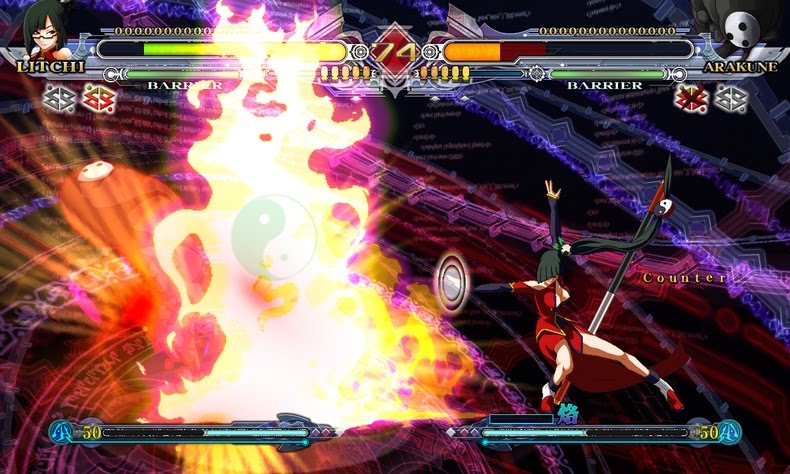
This time last year I gave a rave review to BlazBlue: Calamity Trigger, the new fighting game from the developers of the Guilty Gear series. I didn't expect that I would be back this year to review a new installment in the BlazBlue series, yet here I am, once again delivering a thoroughly positive take on Arc System Works' latest production.

I was slightly disappointed when BlazBlue: Continuum Shift was announced. Though I was glad to see a great game get a sequel, it initially appeared that the "new" game would include relatively little new content. There were four new characters, a few new stages, and adjustments to existing characters, but I worried this would be as disappointing an upgrade as the reiterations of Guilty Gear X2. Given Arc System Works's history, I wasn't wrong to worry, but I'm glad to say that Arc has come through this time. BlazBlue: Continuum Shift is so chock-full of new content that it makes its predecessor's abundance seem paltry.

Though there are several very obvious differences between Continuum Shift and Calamity Trigger, Arc System Works have also demonstrated admirable attention to detail with a whole slew of small changes. The first game's slapdash menus have made way for a more elegant setup. If the short load times bother you, you can now shorten them still further by installing the game, which takes about five gigabytes on the hard drive. All the new characters have new portraits, the art gallery has twice as many unlockables, and the in-battle "HUD" has been redesigned.

When the Guilty Gear games first appeared, they were praised for their beautiful sprite graphics and smooth animation, which made most 2D and many 3D fighting games appear dowdy and outdated. The BlazBlue franchise's HD sprites surpass their Guilty Gear precursors, though I admit I rather miss the old games' sprite backgrounds. The 3D backgrounds in Continuum Shift are lively, detailed, and full of spectators and moving parts, but Arc System Works' 3D output never approaches the beauty of their 2D work. The stages, though not unsightly, represent a missed opportunity.

In an interview from 2008, Daisuke Ishiwatari of Arc Systems Works compared his games with games like Street Fighter IV, which claim to be user-friendly but which are impenetrable to those unfamiliar with fighting games, their history, and their terminology. As he put it: "In my own opinion, no matter what the game, it's important to make sure that beginners and non-gamers can pick it up, and have fun just mashing the buttons." Calamity Trigger, with its Drive (i.e. X Button/A button) attacks and right-stick special attacks, achieved this goal quite well, but Continuum Shift manages to be even more user-friendly. Though you no longer have the option to perform special attacks with the right joystick, Arc System Works instituted a new Beginner Mode which remaps buttons, removes certain of the more arcane techniques, and generally accommodates new players and button mashers. If you'd like to learn the game in-depth, there's also a Tutorial mode that explains the game's various rules, systems, and terminology in a reasonably comprehensible manner. If you're really dedicated, there's also Challenge Mode, which teaches you some very difficult combos. Continuum Shift is as accessible as this sort of game can ever be.

Calamity Trigger featured a Story "campaign" for each character, fully-voiced with multiple endings. The plot features various warring factions, mysterious entities, cat people, squirrel people, two psychotic children, time paradoxes and loops, cursed weapons, damned warriors, flashbacks, violent sibling rivalry, vampires, and ninjas. The characters talk a great deal without explaining very much, and the multiple endings and the characters' tendency to make every meeting end in violent conflict help make the developments even more opaque. Even so, Continuum Shift's Story mode is a great improvement over Calamity Trigger's. Aside from the increase in anime sequences and set piece battles, seeing all the story paths requires significantly less tedium.

Though Continuum Shift is advertised as having four new characters, it would be more fair to say that it has three-and-a-half. New fighter Lamba replaces Nu from the first game; the two characters look and play very similar, though Lambda is all in all less dangerous than Nu, who was after all a boss character. Continuum Shift's one hidden character, Mu, somewhat resembles Lambda, but plays quite differently. Hazama, the villain of the piece, seems like a very difficult character to learn. He can summon green energy chains to bind opponents, jet around the arena, etc. His special and super moves are among the most impressive in the game. The final new character, Tsubaki, is a conservatively-dressed (!!!) female with very easy to perform special attacks. Each of her attacks has four variations; her Drive move charges up a gauge that lets Tsubaki perform especially powerful takes on her moves. She's not a very flashy character, but I've found her a lot of fun to play.

The first BlazBlue received much praise for its "net code". Online matches flowed well and rarely suffered from noticeable slowdown. I've only played a few online opponents in Continuum Shift, but I've already noticed and appreciated a few changes to network play. You now have the opportunity to play Training or Arcade while waiting for a fellow human to come online and interrupt. Match observation has also been improved; you can now join as an observer mid-match instead of waiting at the "Connecting..." screen. Online play as a whole is far better than before; I doubt I shall be able to return to Calamity Trigger.

As happy as I am with Continuum Shift, I still have a few complaints. The enemy AI can be fairly cheap, especially with overpowered characters. Unlimited Hazama, the boss of Arcade, is the case in point: He seems to block everything, has three times your health, can poison you, and regenerates. As you might imagine, fighting him is an exercise in frustration. My other complaint concerns DLC – as I write, one new character is available on the Playstation Store. Two more will appear in the coming months. Each character costs $7.99. This seems exorbitant to me, especially since Story mode is plastered with "ads" for the new characters, all of whom have speaking (but not fighting) roles. At least the game itself is cheap; Continuum Shift launched with an MSRP of $39.99.

Continuum Shift is a fine step forward for the BlazBlue franchise, whatever minor quibbles I might have with it. I look forward to spending more time with it – I've played it a lot already, but I know that I've only scratched the surface. Well-worth the money for those already fans of the series, Continuum Shift is also a fine jumping-on point. Don't worry what you've missed – you still wouldn't understand that plot...

Sunday, June 6, 2010

This "Dead" Franchise Was Just Playing Possum

Rocket Knight is a strange little game but a good one. Like Mega Man 10, it's a platforming throwback – a homage to old games on early systems. Unlike Mega Man, however, the Rocket Knight/Sparkster franchise was, until this year, almost forgotten. Though the series had a few partisans, mostly connoisseurs of mid-nineties games, very few gamers ever expected a fourth Rocket Knight adventure. After all, the last games in the series appeared in 1994. Thus this new game is a windfall for both old Sparkster fans and those, like me, who never had a chance to try the original games.

Despite Rocket Knight's 3D graphics, online functionality, and download-only release, it's hard to miss the fact that the game has roots in the nineties. Today, after all, no company would ever launch an IP about a sword-wielding, jetpacking, steampunk possum. Modern steampunk jetpacking requires Tesla cameos, clunky controls, and Nolan North. Rocket Knight lacks all three and still manages to be a fine game.

The controls are simple – one needs never touch shoulder buttons, adjust the camera, or depress the thumbsticks – yet give Sparkster a wide range of abilities and attacks. The game does a fine job teaching the player all the hero's tricks with unobtrusive tutorial signs in the backdrops of early levels. First-time players can stop, read, and learn, while returning fans can ignore relearning the controls and concentrate on speed runs and shots for the leaderboards– Rocket Knight may be a short game, but it's designed with replayability in mind.

The first few platform sequences in Rocket Knight are fairly simple; environmental hazards are rare and enemies unthreatening. Very shortly, however, Sparkster comes across some truly difficult platforming challenges. The game's third world contains some of the most cunning traps I have seen in recent years. A lesser game might frustrate with instant death spikes, bottomless pits, and scarce check points, but Rocket Knight is relatively forgiving – one mistake won't kill Sparkster, and each level has several checkpoints. Die too many times in Arcade mode and you will have to start again from the game's beginning, but there's also Free Play mode, which, in addition to a level select feature, allows you to play through the game without possibility of permanent loss.

I was very taken with Rocket Knight's platforming segments, but less impressed with the occasional side scrolling shooter levels. While they do offer a change of pace, Sparkster is far less nimble when flying than he is while earthbound. There's only one way to attack your foes, and there's no way to attack any villains who have managed to maneuver behind you. Sparkster can "air dash" with the circle (or B) button, but the trick doesn't satisfy – I think that the dash ought move our hero faster and further. Finally, the level designers have littered the air with far too many floating minefields. Those intricately arrayed clusters of bright bombs don't offer much challenge, and their ubiquity occasionally makes an exciting game feel lazy. Rocket Knight's flight levels aren't terrible or unenjoyable, but I wish that the flying was as well-conceived as the rest of the game.

Rocket Knight is a 2D platformer that uses 3D graphics, and the game sometimes suffers for it. Ninety-five percent of the time everything runs smoothly, but every once in a while it becomes difficult to distinguish between foreground and background. Aside from these moments of confusion, the graphics serve their game well. A few assets repeat too often, but the gameplay variety more than compensates for a little graphical repetition. Though the graphics have slight flaws, the game has a coherent, consistent, and charming aesthetic. Games with far larger budgets and longer development cycles often feel slapped-together and messy; Rocket Knight never does.

Before I close this review, I should mention that I have had intermittent Internet conversations with Rocket Knight's producer. I admit that I expected to like this game but, even so, I was taken aback by how good it is. If you like 2D platforming, chances are you shall like this. I fervently hope that Sparkster doesn't take another decades-long hiatus; I'm already hoping for a sequel. Meanwhile, I think I may have to look up the other games in the series. If they're as good as this game is, they deserve a rerelease.

Sunday, May 23, 2010

The Bumpy Road to Redemption

As Mr. Hollis-Lima said in his previous post, Red Dead Redemption is a fine game. I've spent far too much time playing it this week, and I have no doubt that I shall devote just as many hours to it next week. And yet Red Dead, despite its six-year development, doesn't feel quite so polished as I might have hoped. It's a great achievement for Rockstar, but I can't help but feel it should have been greater.

Red Dead Redemption takes place in somewhere in the Generic West in 1911. There are trains and telegraphs and occasional automobiles, but lives still come very cheap. I suppose that Rockstar wanted to tell a story about the end of the West, which is fine, but the Red Dead world seems too violent to be believable for 1911. Videogames always exaggerate, but this, to me, takes suspension of disbelief a tad too far. Aside from this, the game's worldbuilding is mostly sound, something of a surprise after the maddeningly poor open sequence, where Our Hero rides the train to the town of Armadillo and listens in on some of the most hackneyed, tedious, and implausible conversations ever committed to Blu-Ray. There's a satirical intent – one of the speakers may even discuss Manifest Destiny – but the complete lack of subtlety bodes ill for the remainder of the game. The writing does improve, but never enough to make one forget that ill-starred sequence.

While the West of Red Dead Redemption does offer many peaceful pursuits such as horseshoes, poker, drinking, herding, horse-breaking, and exploration, sooner or later the guns will come out. When they do, many players will be disappointed. There's a cover system, but it's awkward. There's no separate button for hand-to-hand combat, making non-lethal methods very difficult. There's a bullet time mode called "Dead Eye" that's a lot of fun to use, but it makes fights far too easy. Finally, there's very little to remind players that their weapons come from a different era. The guns aren't terribly distinct from those in games set a hundred years later; they just fire a tad slower. And perhaps because one sees the game from over Marston's shoulder, these virtual weapons lack the virtual heft that might make them memorable. I suppose they recoil, but I never notice it. I'm too far removed from the action to see.

Violence in Red Dead Redemption is fast, common, and not terribly effecting. The game borrows its aesthetics from films like The Good, the Bad, and the Ugly and Unforgiven, but the great Western directors knew how to give their gunfights suspense and significance. The Man Who Shot Liberty Valance may be an epic, but there's a grand total of one killing in the entire movie. Or consider the opening to Once Upon a Time in the West: We know to expect killing, but Leone brilliantly draws out the suspense with seeming inconsequential details like the dripping of water or a fly's buzzing. In Rockstar's game instant gratification rules. Perhaps it's a weakness of the medium?

Another problem is the game's save system. There's an auto-save system, and usually a manual save point is only a minute or two away, and, in the wild, players can even strike up a campsite to serve their saving needs. Unfortunately, Red Dead Redemption stops being player-friendly the moment the state puts a price on John Marston's head. Fugitives cannot save in their usual "home" areas, nor can they set up camps. You can't save the game until the bounty is paid or the crime is pardoned. Unfortunately, it's very easy to accidentally commit a crime: the harsh Western climate breeds despair; policemen and civilians have the regrettable habit of throwing themselves between your gun and your target.

Once I lost half an hour of progress because I died without saving, on my way to pay my "debt to society." Cause of death? A glitch that threw my character hundreds of feet into the air. The game celebrated my eventual return to Earth with a display of ragdoll physics and the game over screen. I was not happy. Though Red Dead Redemption usually works very well, it has far more glitches and technical infelicities than most games with $100 million development tags. There's a good deal of clipping, some pop-in, and the occasional freeze. At least I haven't run into the infamous magic carts yet.

Red Dead Redemption is at least a very good game; it may well be a great one. Like Mr. Hollis-Lima, I look forward to playing more of it. I just wish the game had a little more polish, a little more subtlety, and far fewer glitches.

Wednesday, May 19, 2010

Taming the Open World

Grand Theft Auto IV was a great game, but it had its problems. Most notably, it suffered from a crippling discordance between its gameplay and its story. Merely a few hours into Red Dead Redemption, I already feel as though it is shaping up to be a considerable improvement over its spiritual predecessor. Red Dead has an advantage over Grand Theft Auto: cowboys are so very cool, and that type of cool has largely gone untapped by video games. Rockstar has captured every conceivable nuance of that cool in this game, but the genre's effect on the overall experience of the game runs far deeper than most will probably realize. Red Dead is thoughtfully designed to portray the Wild West with true complexity, neither allowing any of its facets to obscure its blemishes nor mute them. While capturing the cool of being a cowboy is one of this game's strong points, the way the game captures the ugliness may just prove to be its most enduring achievement.

Capturing that cool is no small achievement, and Rockstar finds it in the details. If the player taps the up button on the directional pad, the protagonist, John Marston, whistles. No matter where he is, this results in his horse running into the area. It is a great feature from a gameplay standpoint; hijacking as a means of transportation, the go-to in Grand Theft Auto, would be rather difficult in an open desert. (Also, Marston is trying to go straight, gorram it.) Far and away the best part of this feature, however, is how it allows Marston to get a running start and, without ever missing a step, hop onto the horse the moment it comes running up alongside him. Once I discovered this stunt, I never began my travels any other way. It is just too freaking cool to not do. Galloping along a path, at full speed, into the sunset is such a thrill that I look back at Grand Theft Auto and scoff; there is no way that playing as a city-dweller could capture this feeling. It also helps that the few miles of land I have seen thus far are so visually impressive. Day, night, dusk, dawn, cloudy or clear – it is all beautiful. Details like the crystal-clear stars in a sky devoid of light pollution or, yes, even the lone tumbleweed puttering through a quiet town all draw the player into Marston's world.

This nuanced design extends to a careful control of Red Dead's tone as the player traverses its world. Nothing detracted more from Grand Theft Auto IV's story than a lack of such control. The streets were crowded with caricatures of modern Americans and with cars that bounced around the roads like pinballs. It was virtually impossible to prevent the protagonist from plowing down a crowd of fat morons, one of whom would then scream, "Cheesy vagina!" and squander all of a given mission's dramatic weight. It was amusing in a way, but it clashed with the game's very grounded narrative about a man seeking absolution for his dark past. There are no such problems in Red Dead Redemption. The game's satirical streak is woven much more subtly into the experience, and far more importantly, the game design does not force the player to behave in a way that disrupts its own main character's redemption arc. John Marston has an unseemly past, but he is trying to do better. Even at his worst, he has never been in it for cheap, violent thrills, and this game ensures that the player will most likely feel the same way. There are few pedestrians to run over on horseback and, if the player does manage to find one to trample, there is little comedic value to it.

The fact that Marston's morality extends beyond the game's core storyline to pervade the entire experience means that said storyline has exponentially more impact. When something disturbing happens within a mission, the player is actually driven to feel the emotion because the event is not buried in an experience full of whimsical, lighthearted sadism. Grand Theft Auto IV's Liberty City was full of obnoxious, self-absorbed jerks, but none of them perpetrated anything approaching the level of destruction that the player invariably did. Here, Marston only sullies his hands if the player truly wants him to. Consequently even the most sadistic player likely won't be completely numb to witnessing the spectacle of, say, a stickup ending with a shopkeeper getting shot point-blank. The player has not been complicit in a multitude of equally cruel acts, so the events are thrown into relief, and the violence carries weight.

One such instance of violence came when I witnessed a drunk man attempting to rape a woman outside of a saloon. My reaction was to draw my pistol and shoot the man. It not only left me with a strong feeling of righteousness but also the much deeper sensation that I was part of a believable moral landscape. Regardless of whether I had shot the man or simply walked away, my actions would have fit the scale of the game's narrative; it would not have been a bout of cartoonish sociopathy that the game would later have to forget in order to progress the plot. This consistency leads to a more immersive experience than the tonal whiplash caused by Grand Theft Auto's gameplay.

There is a tremendous amount of technical skill evident throughout Red Dead Redemption's world, and it leads Rockstar to the rare achievement of doing justice to the western genre in a video game. The game's careful modulation of tone and morality, however, represents an even greater achievement: Rockstar has elevated the medium of the open-world game.

Saturday, April 17, 2010

Uncharted 2: I'm Still Playing

Way back in October, Me and Matt on Media devoted several posts to Uncharted 2, then the hot new thing on the Playstation 3. I claimed that the single player was a masterpiece, but was slightly less taken with the multiplayer. In this Tuesday's post on patches, Mr. Hollis-Lima criticized some of the changes that Naughty Dog made to their game's multiplayer, though he acknowledged that the developers at least had their hearts in the right places. That the recent patches discouraged us is, in an odd way, a triumph of sorts for Uncharted 2. Neither Mr. Hollis-Lima nor myself expected to be playing Among Thieves online seven months after launch. This multiplayer game, for all its flaws, still has legs.

When Uncharted 2 launched, I found that its multiplayer was enjoyable, but I felt that, amongst other things, there were not enough maps wherein to slay your foes in competitive modes and too few levels for cooperative play. Naughty Dog very quickly began fixing the first of these problems. About a month after the game appeared, a new map, The Fort, appeared as free downloadable content. Alas, this free level was the last substantive addition to Uncharted until the end of February, when two new maps debuted (though this time we had to pay for the new content). Next week another two maps, The Museum and Highrise, should show up on the Playstation Store. Naughty Dog has also stated that they will once again "subtly" rebalance the game – let us hope that these changes will be better-conceived than some past adjustments. Unless the forthcoming 1.07 update utterly ruins the game's balance, I believe Uncharted 2's competitive modes will remain viable for quite some time.

Unfortunately, Naughty Dog has not given Uncharted's cooperative modes enough attention. The game shipped with three great "narrative-lite" levels wherein two to three players fought enemy soldiers, platformed, took on helicopters and tanks, and generally relived the high points of a single-player campaign. The cooperative campaigns were difficult without being unfair, and Naughty Dog employed a number of mechanisms to ensure true cooperative play. I've played through all these scenarios several times, but they eventually seem tired. It's a shame that Naughty Dog has announced there will be no more new story co-op levels until their next game; apparently co-op missions are too resource-intensive to develop.

In addition to the mini-story missions, Uncharted 2 features Gold Rush and Survival modes, cooperative challenges set within the normal multiplayer maps. These are fun, but feel somewhat constrained; to break into cinematic parlance, they lack set pieces and scenery changes. I was glad to hear that next week's update will include Siege, a new cooperative mode in this vein, but I will be shocked if I find the new mode particularly enthralling. I'll doubtless play several Siege matches, but I don't expect to become a habitual user.

I've already discussed my quibbles and frustrations with the Uncharted multiplayer experience; it's somewhat harder to explain why the game still interests me, seven matches and hundreds of matches on. I suppose that the game's greatest strength is its use of space and the game's consequent variety. Uncharted allows the player to roll, clamber, and climb around its environments with far greater freedom than most multiplayer shooters. The map isn't just a backdrop for blood and violence, it's an active participant in the apparent chaos.

It doesn't hurt, of course, that Uncharted 2's various arenas are all beautifully rendered and ornately detailed. The majority of the Facility, for example, is generic industrial chic, but the designers have added small touches of color and beauty throughout: the lovely jungle and blue sky seen through the window, the detailed topographic maps spread over tables and walls, the WWII sub sitting in (mostly) dry dock at the level's center. Every time I play I seem to notice something new, unnecessary, and appreciated.

Since the introduction of multiplayer trophies in February, Naughty Dog has tried to increase Uncharted's variety by incentivizing it. Too few players using those nice explosive propane tanks? Now there's a Trophy for getting twenty separate "BBQ" kills. Too few players using pistols? Come Thursday, there's a Trophy that requires pistol use. Trophies may be silly, but I'm glad to see Naughty Dog using them to make all those rounds of Uncharted fresher and more surprising.

While some of Uncharted 2's failings stem from a lack of content, others derive from technical issues. The matchmaking system is still extremely slow and continues to suffer from occasional crashes. Even worse, the game seems to put matches together without giving much consideration to player level. In your first online game, you might well face a group of people who have spent hundreds of hours mastering every level. I can't imagine starting to play Uncharted today; the learning curve would be far too steep. Once in a match, there's a small chance that you will encounter cheaters; while Naughty Dog has fixed many exploits, enough remain to occasionally make games extremely frustrating.

In the more than a half a year since my last blog post on Uncharted, my feelings about the single player haven't changed one jot. Had the game lacked all its multiplayer modes, it would have remained the best game of 2009. My feelings on the multiplayer, however, have become far more complex than I would have expected in October. Uncharted 2 has a great multiplayer modes, but its shortcomings constantly remind me of how far Naughty Dog still has to go. I don't know how they will ever top the single-player, but the ways of improving the multiplayer are both myriad and obvious.

Saturday, March 27, 2010

The Last One, Volume Thirteen

In my previous post on Final Fantasy XIII, I stated that I liked it as far as I had played it, but that I needed more time with the game to pass final judgment. I've now finished the game, if not all the postgame content, so I feel qualified to finish reviewing it. To be brief: Final Fantasy XIII is a very, very good game, but not, I think, a great one. While not as incompetent or hackneyed as a Resident Evil 5, the game is not as smooth and polished as Uncharted 2which remains the best PS3 game I know. I had an enjoyable time with Final Fantasy XIII, but I'd hesitate to recommend it to anyone with a low tolerance for the Japanese Role-Playing Game.

Perhaps the most frustrating aspect of Final Fantasy XIII is its mixture of very bad design choices with very good ones. The good choices predominate, but the game's flaws never do go away. The plot, for example, is generally well-paced, enjoyable, and avoids the genre's temptation towards verbosity. On the other hand, several interesting plot threads remain unresolved at the game's end and two or three interesting characters disappear far too early. It doesn't seem as if Square-Enix is inserting sequel hooks; it just seems as if they forgot to wrap everything up.

The battle system is a minor triumph for Square-Enix; it's fast-paced, pretty, and fun. It's a shame then that a number of major bosses, particularly those following especially dramatic set pieces, tend to take forever to kill. Once you get into a battle's "rhythm" – you've figured out how much each enemy attack does, when to heal, etc. – you've effectively won. When, five or even ten minutes later your rhythm has become a rut, the game doesn't seem terribly entertaining. Worse, there are a few moments when the game turns truly cheap, as with the penultimate boss, who has a maddening tendency to instant-kill your party leader, thereby sending you to the Game Over screen.

On the other hand, the Game Over screen does give you the option of reconfiguring your party and retrying the fight; dying doesn't necessitate redoing earlier fights or re-traversing completed areas. As a result, I spent far less time cursing in Final Fantasy XIII than I did in many of its predecessors.

When I wrote my last piece on Final Fantasy XIII, I was just about to reach the "open world" part of the game. I very much enjoyed the late-game freedom of exploration, but I wish there were just a little more to explore. Though there are many interesting things to see and do, I was disappointed to see how small the game world was. At one point I completed a sidequest and opened up a sealed optional area. I was very excited to see the new sights and was looking forward to a few challenging boss battles in the newly-unlocked ruined city. Five minutes later I realized that the ruins, ostensibly of a great metropolis, consisted of just a few thousand square feet of real estate. I was even more disappointed when I recollected Final Fantasy XII and its huge and endlessly interconnected world of Ivalice. Final Fantasy XII could overwhelm at times, but I'd rather have its surfeit of levels to explore and creatures to fight than its sequel's relative paucity of choices.

While I may miss some of the features of Final Fantasy XII, the follow-up does fix a number of that game's issues. While Final Fantasy XIII is very hard, it's less frustrating than the twelfth game, which so often withheld save points or killed players at the tail end of an hour-long battle. There's nothing as tedious as XII's one-hundred-floor Pharos dungeon; XIII's closest analogue is actually quite brief. Finally, the battle system in XIII is much more cinematic and interesting to watch than in the rather bland XII.

I may have plenty of criticisms and complaints regarding Final Fantasy XIII, but the fact is that I've spent more than fifty hours playing it. Though I beat Mega Man 10 and played a few multiplayer matches in Uncharted 2, most of my gaming time these past three weeks has belonged to the newest Final Fantasy. Role-playing games as good as this don't come around very often. If you like the genre or want to try it, Final Fantasy XIII would be a fine pick.

Sunday, March 21, 2010

Deja Blue All Over Again

When Mega Man 9 appeared in 2008, most fans were pleasantly surprised by developer Inti Creates' decision to craft the new game in 8-bit NES style. Mega Man 9, Capcom promised, would not repeat the mistakes of its predecessor: Awkward "2.5D" platforming, an over-elaborate plot involving space robots, and awful forced scrolling levels. Mega Man 9 was a critical success, and I doubt it cost much at all to develop, so I was hardly surprised by the announcement of Mega Man 10, once again a faux-NES downloadable game.

I grew up on Mega Man games; I like to think I know the series' myriad trips pretty well and that I'm pretty good at running and gunning. Still, I don't have the patience that I had as a ten-year-old. So, I was very glad to see that the new game included an Easy Mode, where many instant death pits and spikes are covered, there are fewer enemies, and our hero has more health. Thus far, I've only completed the game's lower difficulty; my ventures into Normal Mode have made me sure that the new Mega Man game is just as difficult as past adventures.

While I found Easy sometimes painfully simple, it's still significantly harder than many of today's action games. Even on this most merciful of settings, there are dozens of pits and spikes to put an end to the Blue Bomber. There will be occasional screams and curses, but in my experience, almost all of my deaths were my fault. Only very rarely did I feel that the game was unfairly laid out. This is quite a relief, especially when I remember some of the cruelties Inti Creates has inflicted on Mega Man fans in the past (note the copious spikes).

I was initially disappointed to see that Mega Man 10 had dropped Mega Man's classic charge shot and slide moves, but Inti Creates has very generously given us a second playable character, Proto Man, whose moveset almost replicates my preferred Mega Man. As with most traditional entries of the series, Mega Man 10 features eight different "Robot Master" levels followed by a jaunt through final boss Dr. Wily's "castle" and a final multipart duel with the evil doctor.

As I haven't played all the Mega Man games, I can't necessarily offer an authoritative opinion on the quality of this game's Robot Master bosses, but I tended to like them. Sheep Man, for example, is wonderfully campy – a robotic sheep with lightning attacks who presides over a math-and-computer themed level. It may not make much sense, but it's exactly the sort of oddity one expects from an NES game. Another example: Strike Man specializes in sports, so of course there are spiked rocket soccer balls all throughout his level. Mega Man 10 is weird, but it's weird in the right way.

Mega Man 10 is a very short game – there's a Trophy unlocked for beating it in under an hour – but it's one that demands replaying. Right after I finished up Easy Mode with the default hero, I decided to try Proto Man. Later I might very well go through Normal Mode with both. In a few weeks, a third playable character (who can double-jump and shoot in eight directions) will appear as DLC. And even aside from that, Mega Man 10 features dozens of short challenges, everything from navigating tricky rooms without shooting to defeating bosses.

Capcom has even included online leaderboard support; it's very funny to see such a "modern" institution as the PSN leaderboard portrayed in 8-bit style with pixelated and hard-to-read type. Mega Man 10 almost never drops its "old school" facade; one can almost believe this game is twenty years old. When the game does drop its pretense, it's usually in service of the player – the NES didn't have shoulder buttons, for example, but Mega Man 10 lets you shuffle through your acquired weapons with L1 and R1.

I enjoy Mega Man 10, but I wonder what will come next for the series. I wouldn't mind a few more NES-style games, but I'd be more impressed if Inti Creates tried to create a good SNES- or PSX-looking Mega Man. With their four Mega Man Zero games and their two Mega Man ZX installments, the company has shown that it's very good at making more "modern" platformers. I should love to see a downloadable game with the graphics and mechanics of Mega Man X4 or Mega Man ZX Advent. Nostalgia and returns to the past are great, but I somehow think that this developer can do more with this franchise.

Whatever my reservations, I'm still very happy with my purchase of Mega Man 10. For $10 it's a fantastic deal, unless of course you simply must have shiny graphics. And while Mega Man 10 does cater to the nostalgic, the introduction of Easy Mode and the two different heroes help make Mega Man 10 accessible and enjoyable for those who might not have spent large portions of their childhood playing Mega Man games. Who knows, maybe I can convince Mr. Hollis-Lima to give it a shot?

I should really get back to playing the game... My ten-year-old self is ashamed of my use of Easy Mode. I should really try and mollify him.

Wednesday, March 17, 2010

Waggle 2.0: Still for Noobs Only

When Mr. Keeley and I discussed the Wii a few weeks back, I concluded that motion gaming's future looked more promising on the two other systems – Xbox 360 and Playstation 3. Sony seems to agree since, last week, they announced Playstation Move. This is not an autonomous system; like Microsoft's camera-based Project Natal, it will serve as a relaunch of sorts for the company's existing system. Because of this, Move has a bit more work to do than the Wii did. It must rope in casual gamers while still appealing to discerning hardcore gamers. In other words, it has to be every bit as inviting as the Wii but offer some genuine depth.

The way Sony chose to unveil this new wand/camera control system to the public showed a clear focus on the former: Wooing the Wii crowd. One of the first games they unveiled is a naked attempt to emulate Wii Sports, but in HD – Sports Champions. Sony claims that the Move controller is far more precise than the Wiimote and that this will markedly enhance the experience. It will be impossible to assess the quality of the gameplay before it is released, but the game's subject matter clearly suggests that the Playstation Move is more an upgrade over the Wii than an attempt to reinvent motion gaming.

That fact only became harder to ignore as Sony trotted out a slew of party games and rail shooters at their press conference. The technology may have been upgraded but the creativity has not.

Naturally, if the motion-centric games are proving hopelessly shallow and derivative, an alternative lies with games that deign to incorporate motion as a secondary form of control. Cue LittleBigPlanet. The demo Sony provided illustrated how this constantly evolving game can grow to incorporate motion control. Users will be able to create levels that are played normally by one person but contain obstacles that require assistance from a second person with Move. It was not entirely organic, with one person controlling the onscreen character and another controlling a disembodied force, but it seemed like it had some potential.

The other entry in this category was SOCOM 4, the latest in Sony's line of military shooters. This game is fully playable with either the traditional DualShock 3 controller or Move. Options are always nice, but this raises a few concerns. First, will the motion control ever be a preferable alternative? It is not likely to prove as precise as the DualShock, especially in a third person shooter. Second, will players using one form of control play against those using the other in online matches? That would create a huge potential for imbalance, as both modes of control will surely have different strengths. Finally, will the added work necessary to implement all of this detract from the overall experience? I cannot imagine that either mode of control will be as tight as it could have been if only one had been included.

Sony clearly wanted to throw serious gamers a bone with SOCOM 4, but I doubt that they will bite, given all of these issues. Furthermore, similar issues will probably plague any other games that try to straddle the line. Sony needs games that are substantive, but still built from the ground up to utilize what the Move has to offer.

Oddly enough, the only game Sony presented that I felt even hinted at this ideal was about as simple as a game could get: EyePet.


Now, this hardly qualifies as a deep game, but I bring it up for the potential it shows. This game illustrates the unique capabilities of the Playstation Move like nothing else does: Nintendo has motion control and Microsoft has camera-based control, but Sony has both. That could result in some surprisingly dynamic and immersive experiences. The number of ways in which players can interact with their EyePet is impressive. There will obviously need to be much more to any games that wish to capitalize on this potential, but EyePet was the only Move game that felt like a glimpse at the future.

Or maybe it was just the pop music.

Even that one flash of excitement I felt was quickly tempered by a dose of reality: This crap is going to be expensive. Sony has promised that a starter pack, including a Move controller, a Playstation Eye camera and a Move-enabled game, will sell for less than $100. Not a bad deal, on the face of it, but when considering the social experience for which these games are clearly striving, one controller simply will not cut it. Some games may even require one person to use two Move controllers or one Move and something called a Sub-Controller (think Wii Nunchuk). So, while experiencing EyePet will only cost $100, experiencing all of the possibilities of Move will cost considerably more.

At the very least, the introduction of Playstation Move represents a renewed commitment to the Playstation 3 on Sony's part. No one wants a new generation of systems anytime soon, and this ensures that it is not coming. At the same time, Move will certainly open up real gaming to new people. It has a unique capacity to bring casual gamers to a system with a deep library, creating a viable path for their growth into serious gamers.

That path will likely lead them to outgrow Move, however. Sony seems to have a weak case for this acting as anything more than a hook for the uninitiated. If that is the extent of their plan, an aggressively priced Move may very well do its job. I would not count on gaining much attention from those who are already on the boat, though; they will see Move for what it is.

Sunday, March 14, 2010

No Rain, but Snow and Lightning

This is the first part of a two-part post on the recently-released Final Fantasy XIII – it's my impressions halfway through the game's story.

I wasn't sure that I would enjoy Final Fantasy XIII. This is a rather strange thing for me to admit, as I had played and beaten nine of the previous twelve games, as well as several Final Fantasy spinoffs. Though the Final Fantasy series has always been known for major changes between installments – each game features a new world, new characters, and a new battle system – some of the things I'd heard about the newest game left me wary. Most importantly, I'd heard that the new Final Fantasy was painfully linear and overly simple. There's some truth to these complaints, but I'm still enjoying Final Fantasy XIII as much as any role-playing game in recent memory.

When Final Fantasy XII appeared almost four years ago, critics and casual fans alike were struck by the game's remarkable nonlinearity, its proliferation of sidequests and hidden areas. One could easily beat Final Fantasy XII in under forty hours – this being a Japanese RPG, forty hours constitutes a shortish game – but there were dozens of hours worth of optional events and missions to complete. The first time Final Fantasy XII lets the player venture outside of a city, the protagonist is tasked with hunting down a few small monsters. Said beasts are easy to find and easier to kill, but if you wander too far from the entrance to the wilderness, you will find monsters so huge that you know you would stand no chance in combat with them. The game gently suggests that you come back later, say, after twenty hours of gameplay.

In Final Fantasy XIII, on the other hand, there are very few places one would ever want to revisit. It's not that the game offers ugly scenery or boring locations; it's just that most of the game's locations are so straightforward and simple that one inevitably does everything on the first trip. I've yet to beat the game, but I understand that exploration finally returns to Final Fantasy for the last few chapters. I do anticipate the Final Fantasy XII-style freeform gameplay, but at the moment, I am perfectly happy with the game's linear progression. While most role-playing games do provide a little more leeway for players, Final Fantasy XIII doesn't herd or push its players any more than games like Uncharted 2 or the perversely compelling Resident Evil 5. Like Uncharted, Final Fantasy XIII gives us enough good plot and good gameplay that we don't mind our lack of agency.

If I were reviewing for a major game site, I would have to provide a somewhat-detailed synopsis of Final Fantasy XIII's plot. I won't bore you with summary and scene-setting, but I will say that Final Fantasy XIII's story has been a nice surprise. The series' previous entry, for all its other virtues, had a fairly awful plot, a steampunk-Star Wars disaster. The game included Vader-like Judges, a Han-esque smuggler and pilot, an evil father, a kidnapped princess, and a less-intimidating Death Star. The parallels were so obvious and numerous that George Lucas should have sued Square-Enix. Final Fantasy XIII suffers from some ridiculous naming conventions – worlds called Pulse and Coccoon, a protagonist who calls herself "Lightning" – but the main the story is interesting. Not only that, it's actually managed to surprise me. Oh, and the Afro-bearing token black man is actually one of the more interesting characters! And looks as if he will survive the game!

Final Fantasy XIII is a very technically impressive game, but at times the accomplished graphics only serve to point out the game's aesthetic failings. I don't mind the character designs, though (as so many others before have stated) they tend to be a tad over-the-top. What really annoys me is the world design – everything is either sleek or ornate, but few of the buildings and structures have an identifiable function. Everything looks great, until you start to think about it. What is supposed to inspire a sense of wonder only elicits a sense of confusion.

The battle system of Final Fantasy XIII isn't nearly as strategic as some of its predecessors, yet its lack of subtlety doesn't really harm it – this is the most visceral of Final Fantasy combat systems. Though the AI controls two out of three characters in a player party, the player can control which "paradigms" the AI players will fill. Mid-battle paradigm switching is quick and necessary; you will die if you're too slow going to a healing paradigm or "debuffing" especially strong enemies. Though Final Fantasy XIII may not offer all that many options to a player, the game nonetheless demands far more attention of its players than most of its genre. As in the underrated and poorly-named Final Fantasy X-2, wandering attention will ruin you.

I wouldn't recommend Final Fantasy XIII unreservedly; it's not a perfect game, and some of its conventions can annoy. It's not a game one has to play ironically, but it does require some patience. If you like Japanese role-playing games, you will almost certainly have fun with the new Final Fantasy. It's a fine, fine game, if you like that sort of thing. I do, and I look forward to spending many more hours with the game. Perhaps portions of these impressions have sounded slightly cool on Final Fantasy XIII – but it's the best thing I have played for months.

Further thoughts will appear on the blog once I've beaten the game.

Wednesday, March 3, 2010

At the Heart of the Storm, Video Games Find Their Soul

This week brings my double-length post on the groundbreaking Playstation 3 game, Heavy Rain. Mr. Keeley will return next week with two posts of his own.

Heavy Rain is not a perfect game. It is an important game.

In fact, it is probably one of the most important games ever made. Not everything this audacious effort attempts is successful, but one very significant part is: It proves that video games are bursting with a potential to convey emotion like no other medium can.

I have wondered if I would ever live to experience a game so profoundly affecting that it could bring me to tears. Heavy Rain comes shockingly close. The game's early chapters are such a potent representation of a life steeped in despair that even the most mundane tasks gain astonishing weight; playing Ethan Mars (Pascal Langdale) in the wake of his son's death is heart rending. He has divorced his wife and lives in a rundown house with his surviving son. Initially, tasks like making dinner for the child may not seem like a compelling prospect – indeed, he will drag a chair to the cabinets and reach in for a bag of chips if you do not – but, the result makes it worthwhile: Ethan stares across the dimly lit kitchen and watches as the child silently eats his frozen dinner. The magnitude of Ethan's loss is suddenly apparent; the life has gone from his existence.

Video game storytelling has improved considerably over the past few years, but few games have truly made story their priority. With Heavy Rain, it is not debatable – the story is everything. Every action the player takes has some sort of impact on the narrative, however big or small it may be. It could cause the death of a main character or it could simply irritate the person with whom you are speaking.

It is essentially a crime thriller – all main characters ultimately find themselves on the trail of the sadistic Origami Killer – but it is decidedly character-driven. Writer/director, David Cage rarely passes up an opportunity to illuminate a character's inner life: A prostitute rebuffs your questioning about her late son, "You may be able to buy my body... but you cannot buy my son," and a detective stops to coddle a baby girl, "Take care of your mommy for me." Even the Origami Killer himself has a tragic backstory. There are a few incidental characters that are far too shallow and one main character's motivations are foggy but, considering the sheer volume of writing necessary here, Cage does good work.

Ethan is not the only playable character, either. There is Scott Shelby (Sam Douglas), the weary but amiable private investigator, Norman Jayden (Leon Ockenden), a drug-addicted FBI agent who is freshly assigned to the case, and Madison Paige (Judi Beecher/Jaqui Ainsley), an insomniac journalist.

The characters are manipulated by a largely contextual control scheme. Walking is the only exception. It is always done by holding down R2 to begin walking and moving the left analog stick to change direction. The mechanic is unwieldy, so it certainly takes an adjustment on the player's part, and it occasionally leads the character to spin around in place, compromising the player's immersion. Nevertheless, the game does not allow the player to move the camera freely, so the design of the walking mechanic makes sense, even if it does not always work well.

Most of the game's controls, however, are a stroke of genius. Apart from the walking, everything is contextual, meaning that players must react to onscreen commands. Dialogue options spin around a characters head and physical actions appear on the object to which they relate. It may sound tedious (indeed, countless games have made similar schemes just that), but Heavy Rain's developers have elevated the "quick-time event" to an incredible means of immersion. If someone is about to slam a door in your face, you stop them by swiping the right stick upward; if you have to climb a muddy hill, you must contort you hand to hold down a series of buttons, just as the character struggles to maintain a foothold; if you are rocking a baby to sleep, you must slide the right stick back and forth, delicately.

Precisely because there are no predetermined controls, the fight scenes in this game are far more intense than those in other games. In a scuffle, the player must scramble to react just as he or she would in real life. In fact, the controls constantly put the player into the thick of a scene's emotions. In stressful situations, even dialogue choices become complicated. The words spinning around a character's head shake and can become illegible as the tension reaches a breaking point. Also, make no mistake: The game will proceed if the player fails to make a choice, and indecision is often dangerous.

No moment is more stressful than those when a life is in the player's hands. Options frantically flash on the screen, characters start to yell, the music swells and, the whole time, the player is desperately struggling to weigh the consequences – consequences that will follow the player through to the end of the game. Even worse, none of these moments have a "right" answer. Heavy Rain goes to great lengths to ensure that moral choices are never black and white; at no time are this game's weightiest choices anything less than excruciating.

Consequently, Heavy Rain is arguably the first game that has ever paid proper respect to human life. It is nearly impossible to think of another game that imbues the act of pulling a trigger with so much gravity; if Modern Warfare were this powerful, most players would be suffering from PTSD after one online match. This achievement in and of itself renders Heavy Rain a landmark. Its creators clearly saw an appalling lapse in the morals of most modern games – one that every gamer knows, but upon which few gamers dare to dwell. Within the game's story, this has considerable significance. Every main character in the game can die and, once dead, he or she will stay dead.

The branching storyline is undoubtedly a draw, but it does result in some issues late in the game. One or two scenes will seemingly reference events that never took place in your story, other scenes will appear to be stitched together, so as to accommodate your customized plotline, and certain subplots will go nowhere, presumably because they were meant for players who made different choices. Also, there are a few situations where the game forces the player to do something that should probably have been optional. Technical glitches arise in the later chapters, as well – musical cues misfire, textures pop in and lip synch occasionally flounders. It is all enough to make the game's ending its weakest part.

Depending on the choices you make, the denouement may do little to rectify things. It consists of a series of short, non-interactive scenes that wrap up each plotline. Some are hugely contrived, pointlessly breaching the game's tone. Other possibilities are considerably more satisfying, even if the experience still feels pieced together.

Still, Heavy Rain is largely a consistent experience. The atmosphere that this unnamed Pennsylvania city provides is a huge achievement. Rain is, predictably, constant, but it is also extremely evocative. (Mind you, it has real significance in the plot.) Whether it is the hiss of a downpour on a deserted street or the tapping of individual drops on a dirty windowpane, the sound design keeps the player immersed in this grim, lonely world. All of that is in addition to the great musical score.

Much of the intrigue of Heavy Rain's environments stems from the fact that most of these locations have never before been rendered in a video game. Yet that is hardly where their appeal ends; the game's visuals are invariably blessed with excellent lighting and art design. The Mars home in the first chapter (prior to any of the tragic events) is a beautiful work of modern architecture that uses open spaces to bathe the entire house in warm sunlight – maximizing the contrast in a game where every other scene is dimmed by thick clouds. Ethan's second home is far more grungy, but no less interesting to behold. It perfectly captures the deep grey of the light on a stormy afternoon and, while it certainly reflects Ethan's depression, it is still a believable home – a chalkboard in the kitchen lists his son's daily schedule in a child's handwriting.

Even less pivotal sets are striking; an alcove full of lockers in a train station is a cave of brushed steel and fluorescent light, and a mansion playing host to a party has more passed out cokeheads in it than pieces of furniture, but the abundance of candlelight and pillows gives it an authentically trendy vibe.

The player's experience in these locations is heightened even further by great camera work. The locked camera positions, both while the player is moving freely and when he or she is not, show that David Cage has an eye for composition. Even taking a seat on a whim leads to a series of shots that are wonderful – a long shot past pieces of furniture emphasizes the character's loneliness, or a close-up reveals the distant look on her face. It makes exploring the environments an unexpectedly personal experience.

Action-oriented scenes are equally well-done, using dramatic camera angles to heighten the impact, but never making it harder to play the game. Even effects like the Hitchcock zoom in surreal drug-withdrawal sequences and 24-like split screens during tense standoffs are used quite well. Many have criticized Heavy Rain for being more movie than game, but with someone like Cage at the helm, this is hardly a flaw.

In such a game, the performances are equally important. Heavy Rain bears mixed results in this area. The developers made a strange choice for this game: They cast French and English actors for a story set in Pennsylvania. Some of the actors' performances suffer due to this more than others. Leon Ockenden, as the FBI agent, is affected the most; his voice seems to flounder between ten different accents throughout the game, rendering his performance quite distracting. He has considerable trouble even pronouncing his own character's name and, furthermore, never manages to connect with the emotion of a given scene.

Pascal Langdale's Ethan also has a heavy accent but is, nevertheless, far more successful. His accent is at least consistent (Hey, Pennsylvania surely has a few immigrants, right?) and he gives a decent performance. Only in the early chapters, when he must repeatedly yell his son's name, does he become a bit comical, but this is the director's fault for not getting a larger number of takes. The other two leads, voiced by Sam Douglas and Judi Beecher, manage perfect American accents and turn in good performances. Madison proves a bit flighty during the course of the game, but Beecher provides a dry humor that brings the character down to Earth. Douglas' performance as Shelby is good, as well, sidestepping clichés and giving the dic an earnest, almost paternal, disposition.

The other half of the performances is the extensive motion capture work. It is largely excellent, especially considering that most of it is rendered on-the-fly by the PS3. Characters move quite naturally and allow Cage's great blocking to come through. Nowhere is this more obvious than in the fight scenes, which benefit greatly from having real humans' performances and not a set of canned animations.

Facial movements, on the other hand, still show the limitations of the technology. Most of it was captured straight from the actors' voice recording sections. As such, it is clear that a performance is constantly trying to come through on the characters' faces, but it is only occasionally successful; the technology often cannot convey the necessary nuance. Nevertheless, the character models are incredibly detailed and their faces are no exception. This game has far more close-up shots than most others, and suffers less for it than one might think.

This game has flaws, to be sure. Yet it is consistently successful enough to make its impact; there are moments of such raw emotion in Heavy Rain that they will stick in the player's memory for quite some time. This is not only due to their immediate power, but also because Heavy Rain opens up a wellspring of new potential for video games. (This, just months after we saw Uncharted 2 do the very same thing.)

It is natural to assume that "interactive drama" will quickly blossom into a new genre of video games, but I am far more excited to see how Heavy Rain's innovations impact the entire medium. This game overcomes countless challenges that other game developers have long been afraid to tackle – challenges that have been holding back the medium for far too long. In other words, every game that follows Heavy Rain will have little choice but to borrow from it and build upon it.

Wednesday, February 24, 2010

The Masters of Uninvolving Gameplay. Sandwich.

Mr. Keeley and I have a running joke. We say that Resident Evil 5 is the only game we have ever played ironically.

It is not just the script; bad video game scripts are a dime a dozen. While Resident Evil 5's script indeed ranks among the worst, this game is inept on every level – from game design to art design to animation to acting. For decades, film fans have been watching terrible movies like Manos: The Hands of Fate or Plan 9 from Outer Space not merely because they tell idiotic stories but also because they are beautifully bad works of filmmaking. Resident Evil 5 is the video game equivalent; it is so earnest and so inept a video game that one cannot help but love it.

As Capcom releases the game's final downloadable episode this week, it presents an interesting quandary for a fan: What should Resident Evil 6 look like? Should the developers attempt to make a modern game – one where players can walk and shoot at the same time?

They risk losing some of the game's charm that way. I have never come to tears laughing at a game before I played Resident Evil 5. Every moment brings a new expression of just how stupid the game's design is. Why does a rocket launcher take up as much space in your inventory as an egg? Why is there a cover system that makes you stand up to heal yourself? Why does 90% of the dialogue consist of "Come on!" and "Okay!"? Why do zombies bounce between walls like ping-pong balls when you shoot them? Why is there a giant, ancient city underneath sub-Saharan Africa that is populated by zombies who operate elaborate booby traps, and also houses a multinational drug corporation headquarters?

At first, these questions frustrated me, but soon I began to see things differently. Watching a massive axe flying through my character and doing no harm, simply because I was in the process of picking up loose change, is not frustrating. It is an amusing sight to behold. Add in cooperative play, where one can share these moments with a friend, and a session of Resident Evil 5 often becomes uproarious.

Still, Resident Evil 5 was not made by a fertilizer salesman on a bet; the game was a multimillion-dollar production. This fact is apparent when looking at the game – character models are extremely detailed and effects like mutating creatures are excellent. So, while kitschiness can be forgiven to some extent, a big-budget series continuing down such a path would be difficult to excuse.

Resident Evil has been in this position before. Back in 2004, much of the gaming press was criticizing the series as stale and archaic. After all, the early Resident Evil games had a camera system that made walking in a straight line across a room one of the games' greatest challenges. The fact that the games still worked this way well into the 21st Century was a joke. But in early 2005, Resident Evil 4 came out and brought the series to the forefront of action/horror games. The player was granted freedom of movement that was more consistent with games of the time and quick-time events (Press B now to dodge the axe!) gave the game's cutscenes greater immersion. It looked like Resident Evil was back on track.

Naturally, when it took five years to release 5, expectations were running a bit high. Revolutionary sequels like Uncharted 2, Mass Effect 2 or Assassin's Creed II only took a couple of years to develop, after all. Yet what fans received was a hollow retread of 4 – a game that made few improvements and that proved many of its predecessor's innovations had now become clichés. (Every mediocre game is now riddled with tedious quick-time event sequences; they are a bane of modern gaming.) It also proved that, while 5's failures were often amusing in how miserable they were, the series would again be forced to evolve in order to survive.

I do not know what Resident Evil 6 should look like. I could create a list of suggestions but, really, what it needs are things that I have not yet seen. With the release of Mass Effect 2 last month and Heavy Rain yesterday, I feel as if the rule book for video games is being rewritten on a weekly basis. Video games are now more emotionally engaging than ever before – I let out involuntary yells as I leap out of collapsing buildings in Uncharted 2; my lip quivers as I play with my only surviving son in Heavy Rain. Today, video games clearly have the power to scare the crap out of me.

I want Resident Evil to make it happen, but it is up to the developers to figure out how that can be done. They can start by making a new game – not the same one I have already bought twice. I doubt that I will find another failure very endearing.

Wednesday, January 27, 2010

You Can't Go Home Again

This time last year, I was thrilled with Playstation Home. Much to the frustration of my friends and girlfriend, I would spend hours each week jogging around this virtual neighborhood of dead-eyed mutes. Yet even then, I knew it was more in anticipation of what was to come than it was because of the experience it offered at the time. Playstation Home has been in its "open beta" phase for just over thirteen months now, and it is hard to deny that it has grown, but has it really delivered on any of the promise it once had?

I think that depends on who you ask. PS3 fans at the time (the few that there were) had visions of a slick, virtual world where users would be able to seamlessly socialize and access their system's many media functions at the same time. Some even thought that it would supplant the PS3's main menu as the primary means of accessing content, providing something far more engaging and dynamic than any other system could. Sony fueled many of these fantasies but, in hindsight, it clearly had different plans.

As I look back, I now see that the amount of time I spent in Home gradually decreased throughout 2009. Today, not even a biweekly content update can be sure to lure me. Sure, there have been various small successes: The "Xi" alternate reality game was sufficiently deep to keep me coming back, even if I was too impatient to refrain from cheating my way through it. The Ratchet and Clank space had a fun minigame that not only hooked me for a brief time but also forced me to cooperate with other users to win. Even the recent "Sodium One Hub" surprised me by showing how pretty Home can look.

All of these spaces, however, are really just elaborate packaging for one or two stilted, shallow minigames which, in turn, are really just elaborate ads for whatever real game they represent. This is neither what initially drew me to Home nor is it what keeps me coming back; I can get many more games of far higher quality by visiting the Playstation Store or (!) by putting in an actual game.

None of this ever managed to distract me from the fact that Home is failing to perform many of its perceived roles. A year later, I still wonder how I am supposed to use this application as a social network. What is so personal about Home? Avatars and personal spaces should, in theory, fit the bill. In practice, though, they only serve to show how much money I am willing to spend on virtual items. Even if the monetary issue is removed, there is still an extremely limited amount of items from which I can choose. (The amount of apartments available only recently became greater than ten. Who, exactly, was begging for a bobsledder outfit?)

Of course, personalization is not even half of the social networking experience. The majority of it is (wait for it...) socialization. Playstation Home is designed to make this nearly impossible. Not more than a few weeks into the life of Home, public voice chat was disabled, limiting audio communication to personal spaces and user-to-user "phone calls." This left most of the communication to text messaging, whereby messages appear in a bubble above the user's avatar. Simple enough, if all you want to do is say "hi" or yell a racial epithet then flee. Having a conversation is another story. Considering that most of us do not have a Bluetooth keyboard lying around, the text messages require the use of the clunky onscreen keyboard. It makes conversation an excruciatingly slow process.

Even when voice chat can be used, the experience is crippled by bugs and connection issues. Often, inviting more than one other user into my personal space resulted in one of us being unable to speak or hear the conversation. Not that there is much to talk about when visitng a personal space. Early promises of being able to stream video and music to virtual entertainment systems quickly faded into myth. So, after about 60 seconds, visitors will have seen all that any given apartment has to offer (that is, if they do not own that space themselves). Meeting up with friends in public spaces may sound more promising, but this process is quite tedious. Users may only engage in a phone call with one other user at a time. It does work regardless of the users' respective locations in Home, but the limitations of this feature are still downright pathetic. The soon-to-be-released game, MAG will allow dozens of users to chat simultaneously, but Home, an application that is specifically designed for socializing, cannot handle me speaking to two other people at a time? There is no question that the PS3's dedicated chat application is far simpler, faster, more feature-rich.

Even if one only has a single friend, getting to the same location will take some time. Moving between each tiny location in Home is a grind. Each space must be downloaded on the first visit (some spaces are as big as 50MB) and whenever that space receives an update (it is often), another download is required. Once the space is downloaded and installed, connecting to it and loading it can take a good 30 seconds. Once again, I can point to a number of games that handle similar tasks on a far larger scale much quicker. Needless to say, this ensures that Home is in no way more pleasant, intuitive or practical than the the PS3's main menu; Home will never replace it. Home's long stretches of downtime have only served well as moments for introspective questioning like, "Did I really buy this $600 machine so I could do this?" or, "What am I doing with my life?"

That, after all, is what repels me so consistently from Home today. As I am shuffling around the Home Mall, traveling through small crowds of improperly rendered avatars, who congregate for no apparent reason beyond it looking more natural than standing apart, I get a sinking feeling. It becomes undeniable: If I spend any more time scrolling through a clunky menu, looking for a vaguely interesting virtual t-shirt for an avatar that few people will ever give a second look, I am wasting my life.

Playstation Home is a consumerist culture low point – a collection of people willfully submitting themselves to advertisements, not for any real enjoyment, but largely out of a sense of brand loyalty. A year ago, I started using Playstation Home because I was a proud PS3 owner. Today, I have stopped using Playstation Home for that same reason – because there are simply too many better things to be doing with this machine.